


Advertisement|Remove ads.
Franklin Templeton CEO Jenny Johnson Reportedly Flags ‘Very Complex’ AI Debt Financing — Favors Short-Term Investments
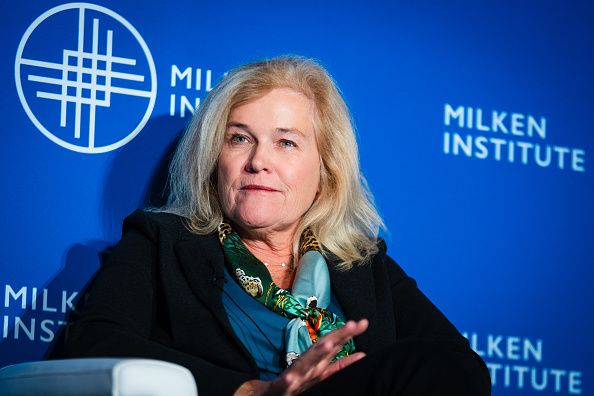


- Jenny Johnson said a December interest rate hike was probable.
- She said economies can perform well with 10-year yields around 5% to 5.25%, provided other parts of the economy remain strong.
- Johnson said the AI story has not played out at all in sectors and traditional businesses.
Franklin Templeton CEO Jenny Johnson reportedly said artificial intelligence (AI) debt financing is becoming “very complex” as technology companies find new ways to fund data centers and computing capacity, while favoring shorter-term investments over longer commitments.
Speaking to Bloomberg Television on Friday at the Milken Institute Asia Summit in Singapore, Johnson pointed to major technology companies' strong cash flows and substantial cash holdings, which she said create opportunities for fixed-income investors.
The executive said these companies are also “not as sensitive” to borrowing costs than many other borrowers.
Advertisement|Remove ads.
Why Johnson Favors Shorter-Term Tech Debt
According to Goldman Sachs data cited by FT, investors have provided about $500 billion in financing to AI-linked companies so far in 2026, including roughly $200 billion to major hyperscalers.
Johnson described a mix of traditional borrowing, off-balance-sheet financing guaranteed by hyperscalers and suppliers increasingly becoming lenders themselves.
She stressed the importance of understanding the full financing picture, including obligations that do not appear directly on balance sheets.
Advertisement|Remove ads.
“Personally, I'd stay probably on the shorter end of that curve,” Johnson said, citing concerns about making long-term commitments based on existing technology when future advances remain uncertain.
“Going longer-term on those would be a little bit more scary for me,” she added
Asked whether hyperscalers' growing reliance on debt markets could signal stress, the Franklin Templeton chief emphasized underwriting individual companies. She noted that widening credit spreads, if fewer investors participate, could create opportunities for fixed-income investors.
Advertisement|Remove ads.
Johnson Says December Rate Hike Probable
U.S. Treasury yields were largely unchanged Friday as investors assessed the latest Treasury auction and President Donald Trump’s pledge to hold off on attacking Iran. The 10-year Treasury yield was flat at 5.2399%, while the 30-year yield remained around 5.6150%.
Johnson also told Bloomberg that a December interest rate hike was probable, but noted that economies can perform well with 10-year Treasury yields around 5% to 5.25%, provided other parts of the economy remain strong.
As of this writing, the iShares 7-10 Year Treasury Bond ETF (IEF) was down 0.38%, while the iShares 20+ Year Treasury Bond ETF (TLT) was down 0.76%. On Stocktwits, retail investors’ sentiment for TLT remained ‘bullish’, while sentiment around IEF flipped to ‘bearish’ amid high message volume.
Advertisement|Remove ads.
AI Productivity Gains Still To Come
Despite concerns about AI financing and market valuations, Johnson sees further opportunities as the technology spreads into traditional businesses. “The AI story has not played out at all in sectors and traditional businesses,” she said, adding, “That is to come.”
The CEO argued that today's 2% productivity gain largely reflects technologies available for the past 20 years rather than AI's latest advances.
In healthcare, she pointed to expanding pipelines of potential drug discoveries and more precise selection of clinical trial participants, which companies believe could improve efficacy and potentially accelerate approvals.
Advertisement|Remove ads.
U.S. stock futures were positive on Friday. Nasdaq futures rose 0.8%, S&P 500 and Russell 2000 futures gained 0.3%, while Dow futures were up 0.1%. On Stocktwits, retail sentiment for the SPDR S&P 500 ETF (SPY) and Invesco QQQ Trust (QQQ) remained ‘extremely bullish.’
See Also: Why Are Nasdaq Futures Surging Premarket? SPCX, ASTS, AAPL, TMUS, VZ, NVDA, MU, LITE Stocks In Focus
For updates and corrections, email newsroom[at]stocktwits[dot]com
Advertisement|Remove ads.
Comments posted here will also appear on symbol pages.

Latest News
/filters:format(webp)https://st-everywhere-cms-prod.s3.us-east-1.amazonaws.com/large_cvs_health_pharmacy_store_sign_58669f89b6.jpg)
/filters:format(webp)https://news.stocktwits-cdn.com/vivekkrishnanphotography_58_jpg_0e45f66a62.webp) Arnab Paul·17m ago
Arnab Paul·17m ago/filters:format(webp)https://news.stocktwits-cdn.com/large_coinbase_new_jul_2eaf8eb2ac.webp)
/filters:format(webp)https://news.stocktwits-cdn.com/Prabhjote_DP_67623a9828.jpg) Prabhjote Gill·25m ago
Prabhjote Gill·25m ago/filters:format(webp)https://news.stocktwits-cdn.com/gettyimages_2294800196_594x594_b8297b0176.jpg)
/filters:format(webp)https://news.stocktwits-cdn.com/Harshita_3cfe02022c.jpg) Harshita Tyagi·45m ago
Harshita Tyagi·45m ago/filters:format(webp)https://news.stocktwits-cdn.com/large_Getty_Images_2261740761_jpg_17808aac0f.webp)
/filters:format(webp)https://news.stocktwits-cdn.com/Whats_App_Image_2026_05_11_at_09_45_43_1_jpeg_a08c0cf251.webp) Aveek Bhowmik·56m ago
Aveek Bhowmik·56m ago/filters:format(webp)https://news.stocktwits-cdn.com/large_palantir_072f76361b.jpg)
/filters:format(webp)https://news.stocktwits-cdn.com/shivani_photo_jpg_dd6e01afa4.webp) Shivani Kumaresan·3h ago
Shivani Kumaresan·3h ago/filters:format(webp)https://news.stocktwits-cdn.com/large_Getty_Images_2290038559_c6f6528203.jpg)
/filters:format(webp)https://news.stocktwits-cdn.com/Revised_Profile_JPG_0e0afdf5e2.webp) Preeti Ayyathurai·3h ago
Preeti Ayyathurai·3h ago