


Advertisement|Remove ads.
Nio Stock Dips In HK After ES9 Debut: What Went Wrong?


- The ES9 starts at 528,000 yuan ($77,230) and will officially launch in late May, with deliveries expected from June 1.
- Nio priced the ES9 about 31% below the ET9 sedan despite sharing much of the same technology stack.
- Reports that Tesla is developing a cheaper electric SUV shifted attention toward lower-cost EV competition.
Advertisement|Remove ads.
Shares of Nio, Inc. (NIO) slid over 5% in Hong Kong trading on Friday after the debut of its flagship ES9 SUV, which has been viewed as the Chinese EV maker's most important product of the year.
Media reports suggest possible profit-taking following the stock's impressive 19% surge in Hong Kong this year and the entry-level figure landing well below the 500,000 yuan floor most analysts had anticipated.
The stock move also comes amid rising competition from Chinese players and Tesla's plans for a lower-cost electric SUV. Nio's U.S.-listed stock slid 5% on Thursday, logging its worst session in three weeks.
Advertisement|Remove ads.
ES9 Launch Tests Premium EV Demand
The ES9 starts at 528,000 yuan ($77,230) with the battery included and is scheduled for official launch in late May, with initial deliveries expected from June 1. The model replaces the ES8 as the company's flagship SUV and is positioned as the most important product of the year.
The ES9 is offered in three trims ranging from 528,000 yuan to 658,000 yuan with the battery included, or from 420,000 yuan to 550,000 yuan under the company's Battery-as-a-Service model. The vehicle runs on a 900-volt architecture with a 520-kW dual-motor system and delivers up to 620 km of CLTC range.
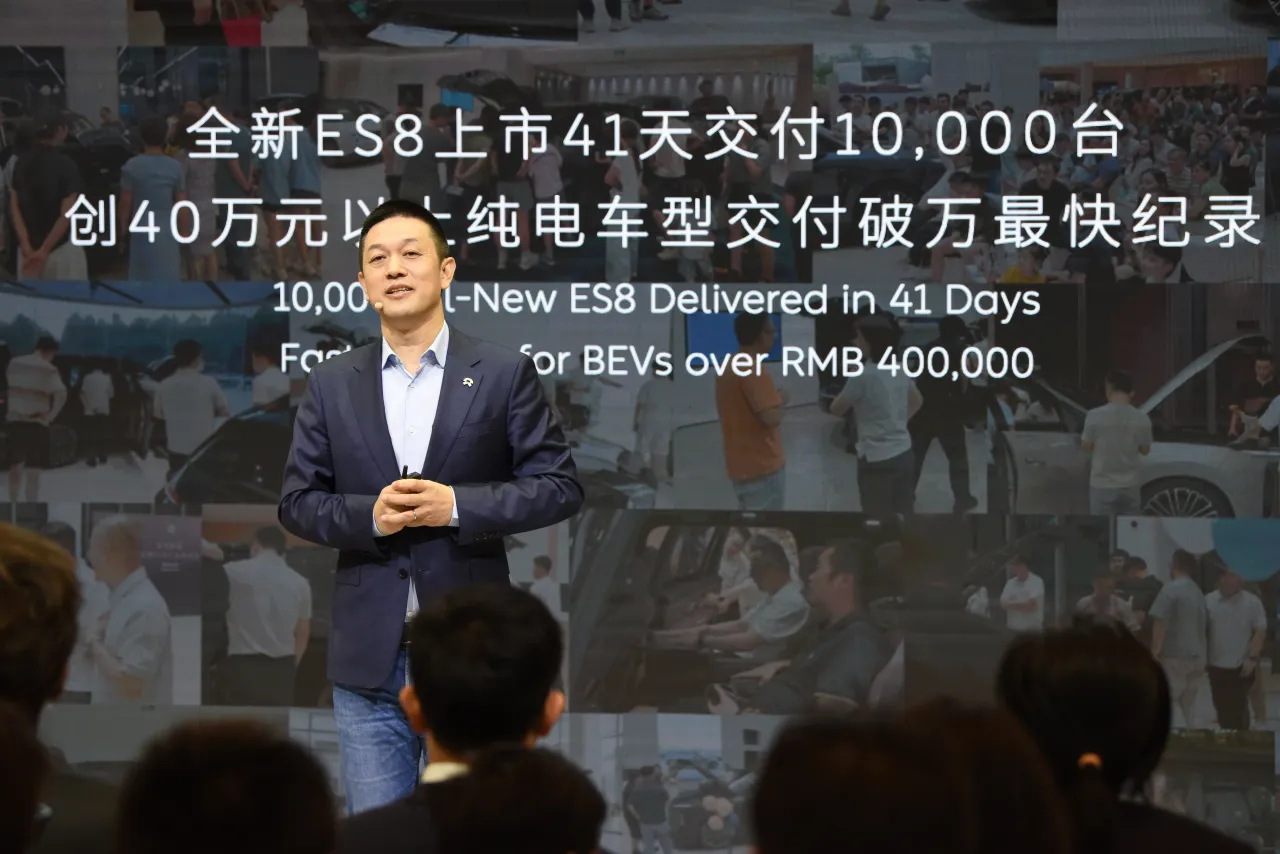
Nio priced the ES9 about 31% below the ET9 sedan despite sharing much of the same technology stack, continuing a strategy previously used with the third-generation ES8 that helped drive strong adoption in the premium SUV segment.
Advertisement|Remove ads.
However, investors appeared unconvinced that pricing alone would replicate the ES8's success. The large luxury EV SUV segment remains challenging, with demand historically stronger for extended-range and hybrid alternatives than for pure battery-electric offerings. Even in competing flagship models such as the Aito M9, the fully electric version accounted for less than 10% of sales in late 2025.
Crowded Premium SUV Segment Heats Up
The ES9 enters one of the most crowded and strategically contested segments in China's premium EV market. The model competes directly with vehicles such as Zeekr's upcoming 9X and the expected three-row XPeng GX SUV, while also facing strong demand momentum from extended-range rivals, including the Aito M9 and Li Auto L9. These hybrid competitors benefit from long-distance usability compared with large battery-electric SUVs.
Although the third-generation ES8 showed that large pure-electric SUVs can succeed within Nio's ecosystem, competitors increasingly rely on hybrid or extended-range architectures that address charging concerns more effectively in the executive segment.
Advertisement|Remove ads.
Tesla Signals Return To Budget EVs
Meanwhile, investor attention has shifted to reports that Tesla is developing an all-new, smaller electric SUV expected to be much cheaper than its current entry-level Model 3 sedan in China.
Tesla has reportedly begun discussions with suppliers about specifications and manufacturing plans for the vehicle, which could be produced at its Shanghai factory and later expanded to the U.S. and Europe. The model is expected to be shorter and lighter than the Model Y, with a smaller battery and a single-motor configuration to lower costs and increase affordability. The project follows Tesla's earlier cancellation of its widely anticipated $25,000 mass-market EV program and signals a potential renewed effort to re-enter the lower-price-volume segment, while still aligning vehicles with its long-term autonomy strategy.
How Do Retail Traders Feel About NIO, TSLA?
On Stocktwits, retail sentiment for both Nio and Tesla was 'bearish' amid 'high' message volumes.
Advertisement|Remove ads.
One user said, "They gonna sell like five es9 lol they can't even sell their regular models!"
However, a bullish user said, "today is another opportunity!!! Hope you took it .. loaded another bundle."
Advertisement|Remove ads.
While U.S.-listed shares of Nio have jumped 83% over the past year, TSLA stock has risen 27%.
For updates and corrections, email newsroom[at]stocktwits[dot]com.
Advertisement|Remove ads.
Comments posted here will also appear on symbol pages.

Latest News
/filters:format(webp)https://news.stocktwits-cdn.com/large_asts_a3f37696a9.jpg)
/filters:format(webp)https://news.stocktwits-cdn.com/IMG_8805_JPG_6768aaedc3.webp) Deepti Sri·10m ago
Deepti Sri·10m ago/filters:format(webp)https://news.stocktwits-cdn.com/large_qualcomm_jpg_bf257cee94.webp)
/filters:format(webp)https://news.stocktwits-cdn.com/IMG_9209_1_d9c1acde92.jpeg) Yuvraj Malik·11m ago
Yuvraj Malik·11m ago/filters:format(webp)https://news.stocktwits-cdn.com/large_BE_Bloom_faee9b1d61.webp)
/filters:format(webp)https://news.stocktwits-cdn.com/Aashika_Suresh_Profile_Picture_jpg_2acd6f446c.webp) Aashika Suresh·34m ago
Aashika Suresh·34m ago/filters:format(webp)https://news.stocktwits-cdn.com/large_Getty_Images_915868956_jpg_408b387146.webp) Deepti Sri·48m ago
Deepti Sri·48m ago/filters:format(webp)https://news.stocktwits-cdn.com/large_Getty_Images_2249581920_jpg_e0f76b0419.webp)
/filters:format(webp)https://news.stocktwits-cdn.com/shivani_photo_jpg_dd6e01afa4.webp) Shivani Kumaresan·1h ago
Shivani Kumaresan·1h ago/filters:format(webp)https://st-everywhere-cms-prod.s3.us-east-1.amazonaws.com/large_US_Stock_Market_Investing_in_the_United_States_c469bc6f1d.jpg) Aashika Suresh·1h ago
Aashika Suresh·1h ago