


Advertisement|Remove ads.
Nvidia Isn't Afraid Of Google TPUs Or Amazon Trainium: Jensen Huang Says It's 'Not That Easy' Building Something Better
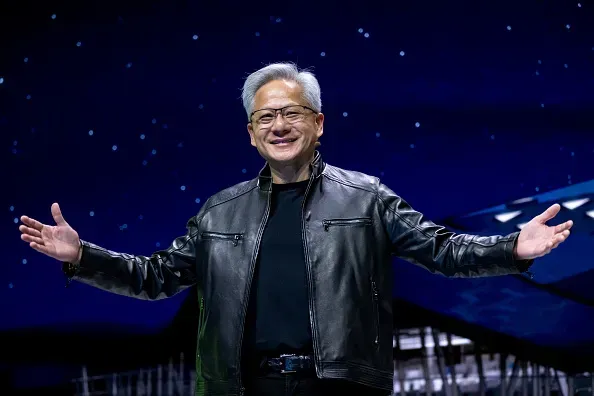


- Huang emphasized Nvidia’s edge lies in its full-stack AI ecosystem, going beyond chip performance.
- Despite rising in-house chip efforts by Big Tech and partnerships such as Anthropic’s with Google and Amazon, demand for Nvidia chips remains strong amid surging AI infrastructure spending.
- Wall Street and retail sentiment remain firmly bullish on NVDA, with the stock extending gains for its 11th straight session.
Advertisement|Remove ads.
Nvidia CEO Jensen Huang pushed back on growing speculation that the bellwether’s dominance in AI compute is vulnerable to rival Google’s TPUs and Amazon’s Trainium chips or others. He argued that building something meaningfully better than Nvidia is “not that easy”.
In a wide-ranging conversation with Dwarkesh Patel, when asked whether rival AI chips could erode Nvidia’s moat, he explained that AI infrastructure goes beyond just raw computing.
The Real Moat: Nvidia’s Full-Stack Ecosystem
He argued that the company’s strength comes from its role as a middle layer in a complex ecosystem that spans TSMC and Micron, among others, as suppliers, and downstream hyperscalers running AI workloads. And this business model makes it harder for competitors to replicate.
“Look at the number of ASICs [application-specific integrated circuits] that have been canceled. Just because you’re going to build an ASIC… You still have to build something better than Nvidia. It’s not that easy building something better than Nvidia. It’s not sensible, actually,” Huang said.
Advertisement|Remove ads.
In his words, it is about converting AI “electrons-to-tokens,” which requires deep engineering across layers rather than focusing on designing a faster chip.
"Nvidia's computing stack is the best performance per TCO [total cost of ownership] in the world, bar none,” Huang said, adding that InferenceMAX, the open-source, nightly-updated AI inference benchmarking framework, backed his claims about Nvidia's superiority over Google's TPUs or Amazon's Trainium chips.
“I'm not offended by other people using something else and trying things. If they don't try these other things, how would they know how good ours is?”
Flexibility Vs Specialization: GPUs Still Win, For Now
He also pushed back against the idea that Alphabet-owned Google’s TPUs or Amazon’s Trainium chips could replace Nvidia at scale. Huang said that while these chips were specialized, Nvidia’s GPUs were flexible, allowing developers to experiment with new AI models and algorithms, and were available across major clouds, giving them a massive reach across customers.
Advertisement|Remove ads.
AI infrastructure spending continues to surge across Big Tech, with demand still heavily anchored to Nvidia’s chips even as alternatives emerge. Huang’s comments come at a time when Anthropic has deepened its ties with Google, while also working with Amazon. These partnerships, backed by million-dollar investments, have raised concerns that they could lead hyperscalers to move away from Nvidia.
NVDA Stock: Wall Street And Retail Remain Bullish
Analysts, however, broadly agree that Nvidia’s overall position remains strong for now. Of the 60 analysts covering the stock, 57 have a ‘Buy’ rating, 2 maintain ‘Hold’, and only 1 analyst has a ‘Sell’ call, per Koyfin.
NVDA stock has reflected this confidence. The stock rose 2% in Wednesday trading, marking an 11th straight session of gains. It has extended its massive 2025 rally and remains among the sought-after AI stocks. So far this month, Nvidia has hovered near record levels, boosted by demand for its Blackwell chips and continued hyperscaler spending and deals.
Advertisement|Remove ads.
On Stocktwits, retail sentiment for NVDA stands aligned to Wall Street, with the mood improving to ‘bullish' territory from ‘neutral’ last week.
For updates and corrections, email newsroom[at]stocktwits[dot]com
Comments posted here will also appear on symbol pages.

Latest News
/filters:format(webp)https://news.stocktwits-cdn.com/large_Getty_Images_2278739890_98d263493d.jpg)
/filters:format(webp)https://news.stocktwits-cdn.com/Prabhjote_DP_67623a9828.jpg) Prabhjote Gill·11m ago
Prabhjote Gill·11m ago/filters:format(webp)https://news.stocktwits-cdn.com/large_Ouster_jpg_91515cf9d2.webp)
/filters:format(webp)https://news.stocktwits-cdn.com/Heera_1_1c30cb0170.PNG) Heera Hari·15m ago
Heera Hari·15m ago/filters:format(webp)https://news.stocktwits-cdn.com/gettyimages_2286772330_594x594_5adf1ac482.jpg)
/filters:format(webp)https://news.stocktwits-cdn.com/Harshita_3cfe02022c.jpg) Harshita Tyagi·16m ago
Harshita Tyagi·16m ago/filters:format(webp)https://news.stocktwits-cdn.com/gettyimages_2261849872_612x612_a09526ee02.jpg)
/filters:format(webp)https://news.stocktwits-cdn.com/vivekkrishnanphotography_58_jpg_0e45f66a62.webp) Arnab Paul·17m ago
Arnab Paul·17m ago/filters:format(webp)https://news.stocktwits-cdn.com/gettyimages_2149574336_612x612_2819b4d87f.jpg) Prabhjote Gill·25m ago
Prabhjote Gill·25m ago/filters:format(webp)https://news.stocktwits-cdn.com/gettyimages_2244673103_612x612_23fbf7da47.jpg) Arnab Paul·2h ago
Arnab Paul·2h ago