


Advertisement|Remove ads.
Oil Rebounds Amid Inventory Drawdowns, Iran War Uncertainty: Economist Says 'Stay Long'


- Meanwhile, Goldman Sachs analysts Yulia Zhestkova Grigsby and Daan Struyven have said that global crude and fuel inventories are falling at an unprecedented rate this month as the Middle East conflict continues to disrupt supplies.
- The EIA expects global oil inventories to fall by an average of 8.5 million barrels per day in the second quarter of 2026, with Brent prices to hover around $106 per barrel in May and June.
- Economist Steve Hanke believes that now is the time to stay long on oil as the world burns through oil inventories at the fastest pace on record.
Advertisement|Remove ads.
Oil prices climbed higher in Wednesday’s overnight session, as supply tightness from the continued blockade of the Strait of Hormuz and fresh U.S. crude oil inventory drawdowns reversed some of the losses from earlier this week.
Brent crude futures expiring in July traded up about 0.90%, trending at around $105.97 a barrel, while WTI crude futures expiring in June were 1.05% higher, trading at $99.29 a barrel at the time of writing.
Both benchmarks declined more than 5% on Wednesday after U.S. President Donald Trump indicated that negotiations for a peace deal with Iran were in the final stages.
Advertisement|Remove ads.
Oil Inventories Drawdown At Record Levels
U.S. crude oil inventories during the week ending May 15 decreased by 7.9 million barrels, according to fresh data from the U.S. Energy Information Administration (EIA).
The statement noted that the decrease brings commercial stockpiles to 445 million barrels, about 2% below the five-year average for this time of year.
Meanwhile, Goldman Sachs analysts Yulia Zhestkova Grigsby and Daan Struyven have reportedly said that global crude and fuel inventories are falling at an unprecedented rate this month as the Middle East conflict continues to disrupt supplies.
Advertisement|Remove ads.
According to a Bloomberg report, analysts noted that visible oil stockpiles declined by about 8.7 million barrels per day in May, nearly twice the average pace since the conflict began.
“Physical markets continue to tighten, as estimated oil exports through the strait remain at a very low 5% of normal,” the analysts said as per the report.
Oil Forecast
The EIA expects global oil inventories to fall by an average of 8.5 million barrels per day in the second quarter of 2026, with Brent prices hovering around $106 per barrel in May and June, according to its latest release.
Advertisement|Remove ads.
The agency added that as oil production in the Middle East rises, crude oil prices would drop to an average of $89 per barrel in the fourth quarter of 2026 and further to $79 a barrel in 2027.
Economist Steve Hanke believes that now is the time to stay long on oil. “The world CONTINUES burning through oil inventories at the fastest pace on record. STAY LONG OIL,” he said in a post on X, sharing another post showing crude inventories had posted their biggest weekly decline since 1982.
How Are Markets Reacting?
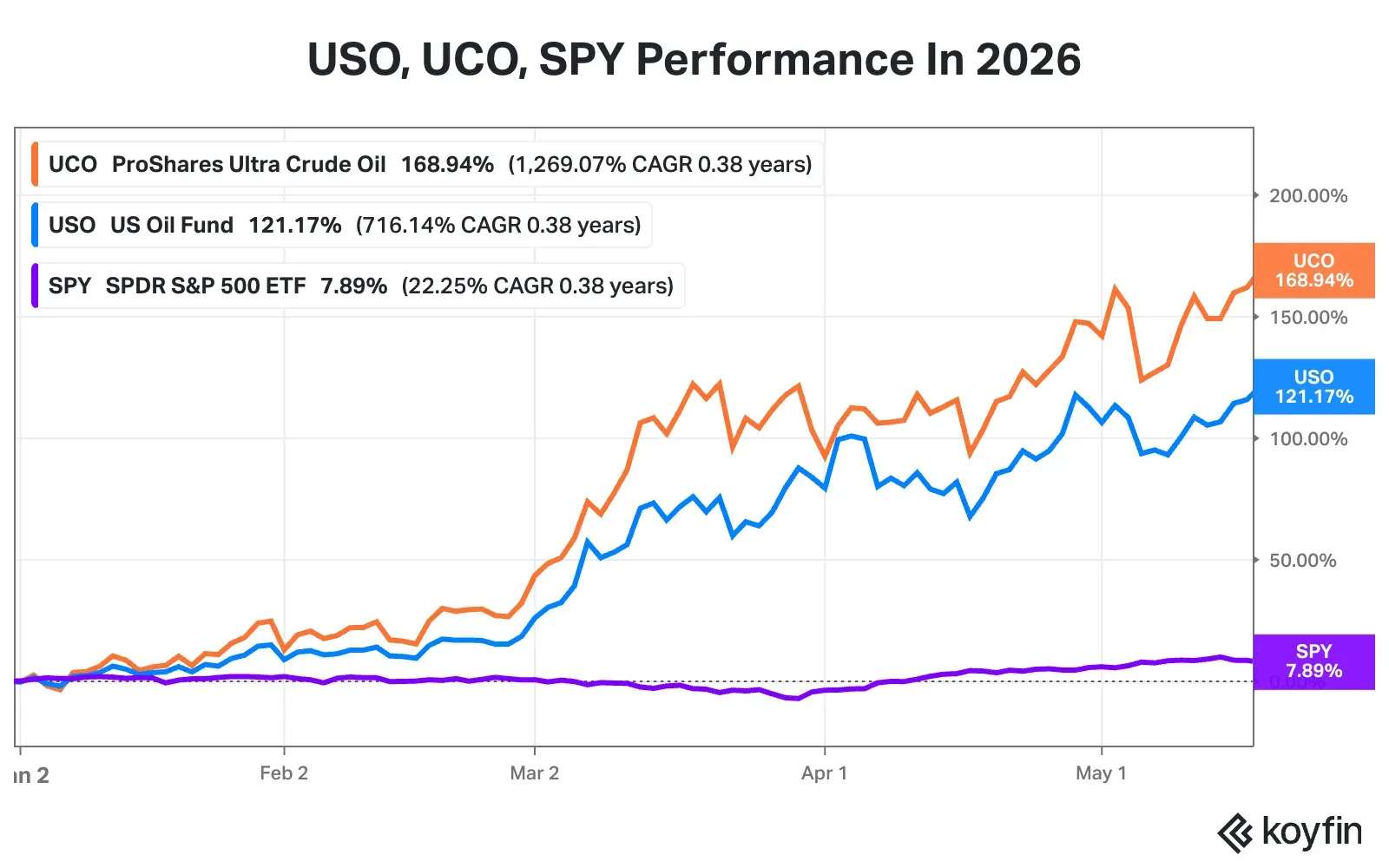
The United States Oil Fund LP (USO) edged more than 1.5% higher in overnight trading after closing down more than 5% lower on Wednesday. The fund’s value has more than doubled since the start of this year. The ProShares Ultra Bloomberg Crude Oil (UCO) has surged about 168% in 2026. In comparison, the fund tracking the S&P 500 index has gained about 8% in the same time.
Advertisement|Remove ads.
Meanwhile, U.S. equities fell in Wednesday’s overnight session. At the time of writing, the SPDR S&P 500 ETF (SPY), which tracks the S&P 500 index, was down 0.20%, the Invesco QQQ Trust ETF (QQQ) fell 0.17%, and the SPDR Dow Jones Industrial Average ETF Trust (DIA) declined 0.07%.
For updates and corrections, email newsroom[at]stocktwits[dot]com.
Comments posted here will also appear on symbol pages.

Latest News
/filters:format(webp)https://news.stocktwits-cdn.com/large_Getty_Images_109203874_8a59b7f214.jpg)
/filters:format(webp)https://news.stocktwits-cdn.com/shivani_photo_jpg_dd6e01afa4.webp) Shivani Kumaresan·21m ago
Shivani Kumaresan·21m ago/filters:format(webp)https://news.stocktwits-cdn.com/gettyimages_1161631184_594x594_0063399eed.jpg)
/filters:format(webp)https://news.stocktwits-cdn.com/IMG_9209_1_d9c1acde92.jpeg) Yuvraj Malik·38m ago
Yuvraj Malik·38m ago/filters:format(webp)https://news.stocktwits-cdn.com/large_Getty_Images_1238006667_7a31c00b79.jpg)
/filters:format(webp)https://news.stocktwits-cdn.com/Aashika_Suresh_Profile_Picture_jpg_2acd6f446c.webp) Aashika Suresh·47m ago
Aashika Suresh·47m ago/filters:format(webp)https://news.stocktwits-cdn.com/Getty_Images_2228901180_jpg_0c2cc7dc28.webp)
/filters:format(webp)https://news.stocktwits-cdn.com/IMG_8805_JPG_6768aaedc3.webp) Deepti Sri·1h ago
Deepti Sri·1h ago/filters:format(webp)https://news.stocktwits-cdn.com/large_Getty_Images_2276204850_jpg_d3bee2e775.webp)
/filters:format(webp)https://news.stocktwits-cdn.com/unnamed_jpg_9dff551b50.webp) Anan Ashraf·2h ago
Anan Ashraf·2h ago/filters:format(webp)https://news.stocktwits-cdn.com/large_Getty_Images_1406494095_158e6a57ac.jpg) Anan Ashraf·2h ago
Anan Ashraf·2h ago