


Advertisement|Remove ads.
Ray Dalio Reportedly Warns AI Bubble Is ‘Close’ To Bursting As Rising Rates Test Debt-Fueled Spending
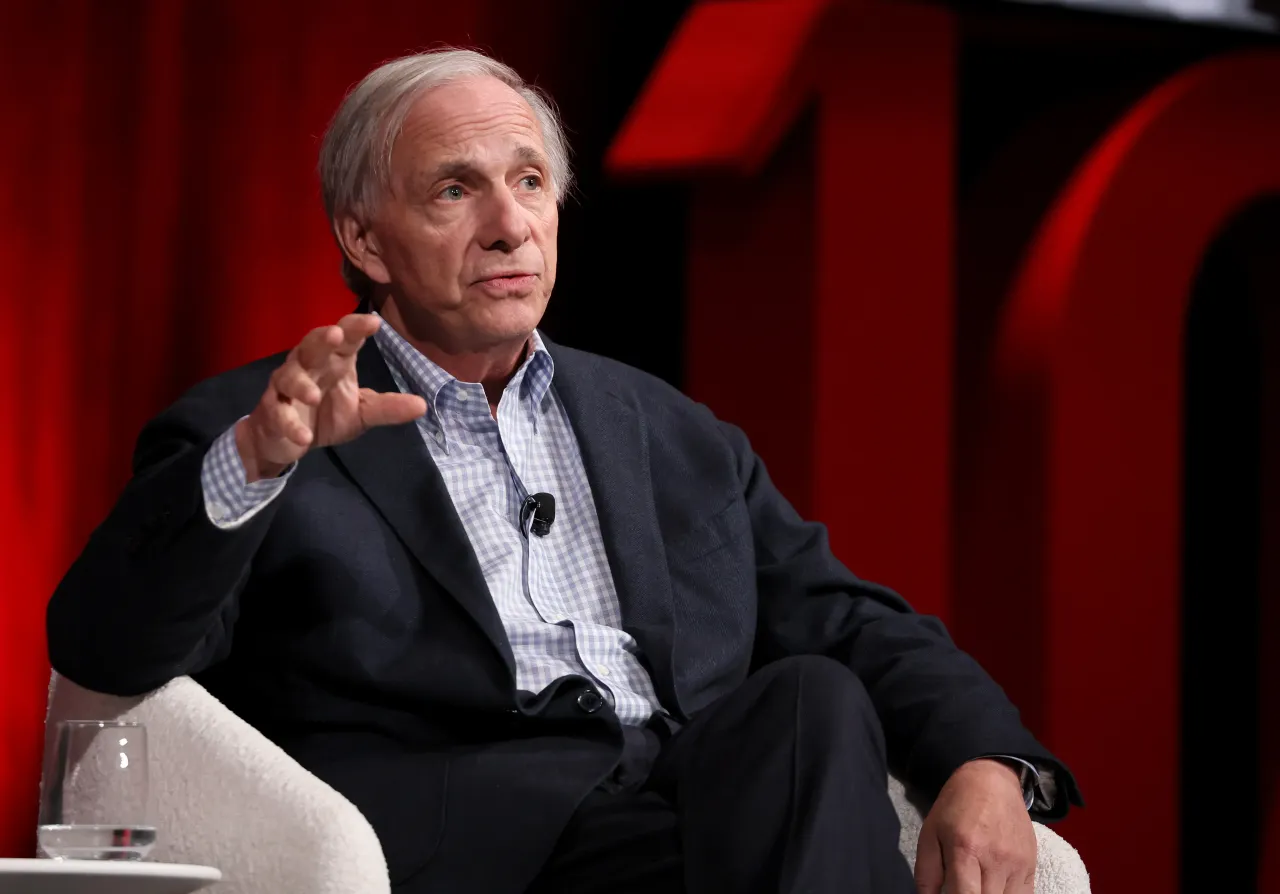

- Dalio said the market is approaching the stage where rising interest rates could begin to deflate the AI investment boom.
- Situations that force investors to turn paper wealth into cash could also push asset prices lower, said Dalio.
- AI infrastructure spending is expected to exceed $795 billion in 2026 and top $1 trillion in 2027, Reuters reported.
Advertisement|Remove ads.
Bridgewater Associates founder Ray Dalio warned Wednesday that artificial intelligence (AI) has become a “classic bubble” and said markets are approaching a point where rising interest rates could trigger an unwind.
“We’re in the part of the cycle that is before that but approaching that,” Dalio said at the Forbes Global CEO Conference in Singapore, according to Bloomberg. “I think we’re close to that.”
Dalio said a large amount of debt is being raised to fund AI investment, making financing costs increasingly important as interest rates rise. He also pointed to situations that force investors to convert paper wealth into cash as another potential trigger for falling asset prices.
Advertisement|Remove ads.
Earlier this week, he warned that the U.S. Treasury market could become more vulnerable if China and Japan reduce their purchases of government debt. In an interview with Bloomberg on Tuesday, he said the U.S. could face a debt crisis within three years as borrowing costs rise and foreign demand for Treasuries weakens.
Big Tech Debt Rises Alongside AI Spending
Dalio’s comments come as technology giants pour hundreds of billions of dollars into AI infrastructure, increasingly using debt, while market gains remain concentrated in a small group of stocks. At the same time, global bond yields have climbed to multi-decade highs, raising financing costs.
Recent regulatory filings show borrowing has increased at some of the largest AI spenders, although the companies generally describe bond proceeds as being for general corporate purposes rather than specifically earmarking them for AI.
Advertisement|Remove ads.
AI infrastructure spending is expected to exceed $795 billion in 2026 and climb above $1 trillion in 2027, according to Reuters, as Microsoft, Alphabet, Amazon, Meta and other technology companies continue expanding data-center capacity.
Dalio is not alone in focusing on the AI bubble and the financing behind the AI buildout.
Burry Also Moves Up AI Bubble Timeline
Michael Burry has also grown more bearish on the timing of an AI downturn. In late September, he said he was “moving timelines up” and shifted several AI-related short positions into put options, saying he believes the “bubble in AI may burst sooner rather than later”.
Advertisement|Remove ads.
Burry shifted bearish bets on Micron, Nebius, the iShares Semiconductor ETF (SOXX) and Palantir into put options, while citing concerns that future AI revenue may not justify the industry’s current capital spending.
In an August note, the investor, famous for his big short on the U.S. housing market prior to the global financial crisis of 2008, wrote that capital flowing through the AI ecosystem was increasingly debt-funded, saying that dynamic puts the bubble “on a clock” because debt carries a concrete cost of capital.
US Stock Futures Slip
U.S. equity futures inched lower early Wednesday after the S&P 500 and the Nasdaq index clocked fresh highs in the previous session. Dow futures were down about 0.19%, while Nasdaq-100 futures fell 0.42%. The S&P 500 futures were down 0.15%.
Advertisement|Remove ads.
Among ETFs tracking benchmark indexes, the SPDR S&P 500 ETF (SPY), the SPDR Dow Jones Industrial Average ETF Trust (DIA), and the Invesco QQQ Trust (QQQ) were down at the time of writing.
Treasury yields moved higher ahead of a closely watched 10-year note auction. The iShares 20+ Year Treasury Bond ETF (TLT) was down 0.69% amid ‘bullish’ sentiment.
For updates and corrections, email newsroom[at]stocktwits[dot]com.
Advertisement|Remove ads.
Comments posted here will also appear on symbol pages.

Latest News
/filters:format(webp)https://news.stocktwits-cdn.com/large_Getty_Images_2205749784_1_jpg_248e46cc85.webp)
/filters:format(webp)https://news.stocktwits-cdn.com/vivekkrishnanphotography_58_jpg_0e45f66a62.webp) Arnab Paul·52m ago
Arnab Paul·52m ago/filters:format(webp)https://news.stocktwits-cdn.com/large_Getty_Images_2271511203_8eff84cf59.jpg)
/filters:format(webp)https://news.stocktwits-cdn.com/Anushka_Basu_make_me_smile_in_the_picture_b92832aa_af59_4141_aacc_4180d2241ba8_1_2_png_1086e0ed8c.webp) Anushka Basu·1h ago
Anushka Basu·1h ago/filters:format(webp)https://news.stocktwits-cdn.com/gettyimages_2283723097_594x594_6bd6cc0d66.jpg)
/filters:format(webp)https://news.stocktwits-cdn.com/1707726834303_jpg_11f20a9aa9.webp) Shashank Nayar·2h ago
Shashank Nayar·2h ago/filters:format(webp)https://news.stocktwits-cdn.com/gettyimages_2298925603_594x594_36977deadb.jpg)
/filters:format(webp)https://news.stocktwits-cdn.com/Harshita_3cfe02022c.jpg) Harshita Tyagi·2h ago
Harshita Tyagi·2h ago/filters:format(webp)https://news.stocktwits-cdn.com/large_Getty_Images_2301854791_367da93dae.jpg)
/filters:format(webp)https://news.stocktwits-cdn.com/unnamed_jpg_9dff551b50.webp) Anan Ashraf·2h ago
Anan Ashraf·2h ago/filters:format(webp)https://st-everywhere-cms-prod.s3.us-east-1.amazonaws.com/large_EQT_resized_b638009335.jpg) Arnab Paul·2h ago
Arnab Paul·2h ago