


Advertisement|Remove ads.
Sellas To Present SLS009 Data At American Society of Hematology – Initial Results Of Therapy In Newly Diagnosed AML Patients Expected In Q4


- The treatment achieved a 54% response rate and median survival of 5.8 months in patients with monocytic AML.
- The combination also showed a 57% response rate and median survival of 8.8 months in patients with TP53-mutated AML
- Sellas is testing SLS009 in an 80-patient Phase 2 trial involving newly diagnosed AML patients.
Advertisement|Remove ads.
Sellas Life Sciences (SLS) was in the spotlight on Wednesday after the biotech firm said it will present Phase 2 results for its experimental blood cancer treatment SLS009 at the 68th American Society of Hematology (ASH) Annual Meeting next month.
ASH is the premier event in hematology that has been going on for nearly 70 years.
SLS shares were down about 2% at the time of writing.
Advertisement|Remove ads.
SLS009 Combination Therapy Shows Encouraging Response Rates
The Phase 2 study evaluated SLS009 alongside chemotherapy drug Azacitidine and Venetoclax, a targeted therapy, in 62 patients whose leukemia had relapsed or had not responded to previous venetoclax-based treatment.
Patients with monocytic AML achieved a 54% response rate and a median survival of 5.8 months, while patients with TP53-Mutant AML achieved a 57% response rate and a median survival of 8.8 months. This compares with historical survival of about 2.5 months.
“The response rates of 57% in relapsed TP53-mutated and 54% in relapsed monocytic AML are encouraging and suggest that SLS009 acts on the biology that drives resistance,” said Joshua Zeidner, Principal Investigator and Professor of Medicine at the University of North Carolina, Lineberger Comprehensive Cancer Center.
Advertisement|Remove ads.
Sellas is also testing SLS009 in an 80-patient Phase 2 trial involving patients with newly diagnosed AML, with initial results expected in the fourth quarter (Q4) of 2026.
Preliminary Topline GPS Data Expected In Q4 2026
Last month, Sellas announced that its Phase 3 REGAL trial of Galinpepimut-S (GPS), an experimental cancer vaccine, had recorded its 80th event, referring to the number of patient deaths.
This triggered the final analysis of the 126-patient study, which evaluates whether GPS can extend survival in AML patients who achieved remission after their cancer returned. The company expects to report preliminary topline results this quarter, although it has not specified a date.
Advertisement|Remove ads.
Retail Remains ‘Extremely Bullish’ On SLS
Retail sentiment surrounding SLS on Stocktwits remained ‘extremely bullish’ over the past 24 hours.
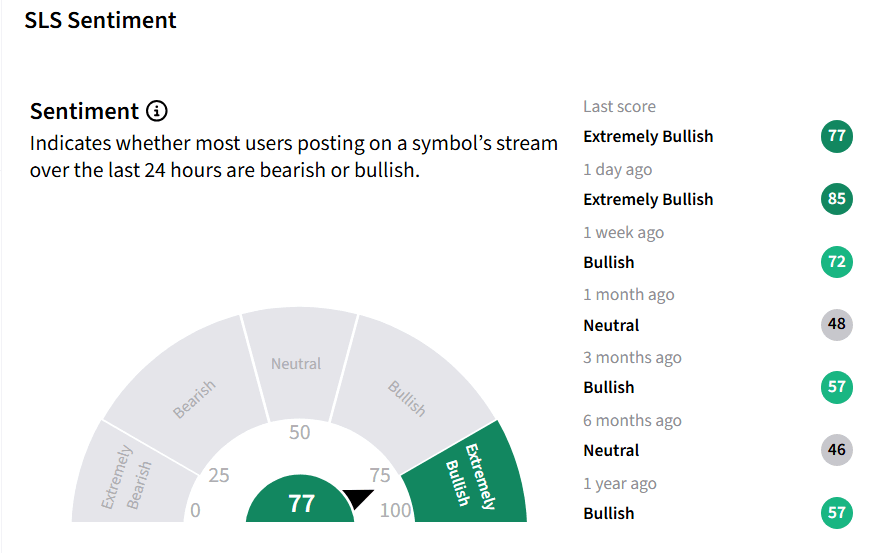
SLS shares are up nearly 100% so far this year.
Advertisement|Remove ads.
For updates and corrections, email newsroom[at]stocktwits[dot]com.
Comments posted here will also appear on symbol pages.

Latest News
 Prabhjote Gill·23m ago

 Shashank Nayar·45m ago

 Arnab Paul·57m ago
 Prabhjote Gill·1h ago

 Heera Hari·2h ago
 Arnab Paul·2h ago