


Advertisement|Remove ads.
Could SpaceX Become The First $20 Trillion Company? Gavin Baker Lays Out The Starship And Orbital AI Thesis



- Gavin Baker’s bull case suggests reusable Starships and orbital AI could eventually propel SpaceX toward a world-first $20 trillion valuation.
- Elon Musk dismissed cooling-related skepticism, saying that critics often lack key technical inputs needed to assess orbital AI systems.
- SpaceX and Nvidia are targeting late 2027 for a space-optimized Vera Rubin NVL72 launch.
Advertisement|Remove ads.
SpaceX (SPCX) could become the world’s first $20 trillion company if reusable Starships make Nvidia-powered orbital data centers commercially viable, according to a bull case outlined by Atreides Management founder Gavin Baker.
SPCX stock ended August 33% higher, rebounding sharply after plunging 36% in July.
SpaceX Bull Case Hinges On Orbital AI
Andreessen Horowitz partner David George recalled Baker previously saying: “I have no idea, but I know which one’s going to be the first $20 trillion company.” Baker explained in an interview how orbital AI and high-frequency Starship launches could support it.
Advertisement|Remove ads.
Baker said orbital data centers could be airplane-sized, using solar-panel wings for power and radiators to reject heat. “You have 10,000 of the world’s smartest engineers at SpaceX who’ve thought about this each for hundreds, if not thousands of hours,” he said. “It’s a solved problem, and in their minds, it’s dramatically simpler and easier than a Starlink satellite.”
“There’s not a physics reason why this can’t work,” Baker added, predicting that “an increasing fraction of the world’s compute is going to be in orbit.” Terrestrial data centers would remain valuable for latency-sensitive workloads, but orbital systems could provide “swing capacity” as power, cooling and material constraints intensify on Earth.
Baker later mocked critics on X who dismissed orbital compute after studying the subject for only a few hours. SpaceX CEO Elon Musk responded that skeptics claiming orbital AI is impossible because of cooling often lack basic inputs such as “heat rejection of the radiator per m^2, coolant temp or max operating temp of the GPU.”
Advertisement|Remove ads.
SpaceX, Nvidia Target 2027 Orbital AI Launch
SpaceX and Nvidia have already designed a space-optimized Vera Rubin NVL72 system targeted for launch in the fourth quarter of 2027. SpaceXAI’s first-generation Starmind satellite will adapt Nvidia’s architecture for operation in orbit, with significant scaling planned for 2028. “Elon said that he and Jensen have co-designed a Rubin rack,” Baker said. “Nobody’s really paying attention to this,” he added. “It’s kind of happening in plain sight.” Baker also called Nvidia “the center of all of it” in AI, saying: “The last 26 years have taught me not to bet against Jensen.”
For Baker, Starship reusability is the decisive factor. “The question people should be asking about orbital compute, which is the one SpaceX is focused on, is Starship reusability,” he said.
Orbital facilities could use solar energy and radiators while avoiding several costs associated with terrestrial data centers. As expenses rise on Earth and reusable launch costs fall, Baker said, “the economics just instantly flip.”
Advertisement|Remove ads.
Starcloud’s Philip Johnston said the breakeven launch cost for orbital compute has improved from about $500 per kilogram to nearly $1,000 per kilogram as terrestrial computing becomes more expensive. This raises the price at which space-based systems can remain competitive, lowering the hurdle Starship must clear.
Morgan Stanley Sees Orbital AI Dominating SpaceX Revenue
Meanwhile, Morgan Stanley said investors are underestimating SpaceX’s Starship infrastructure. “We do not believe investors appreciate the scale of what SpaceX is planning with Starship,” the brokerage said.
The firm expects orbital compute to generate more than 80% of SpaceX’s launch revenue beginning in 2032. Its 2040 forecast of $3.5 trillion in annual revenue requires eight pads operating two launches per day, while 15 potential pads are identifiable across Texas, Florida and Louisiana. Morgan Stanley estimates each additional gigawatt of computing capacity could add $27 to SpaceX’s share value. Morgan Stanley forecasts 4.9 gigawatts by fiscal 2027, well below SpaceX’s internal target of nearly 10 gigawatts.
Advertisement|Remove ads.
How Do Retail Traders Feel About SPCX?
On Stocktwits, retail sentiment for SPCX has been ‘bearish’ over the past week amid ‘extremely low’ message volume.
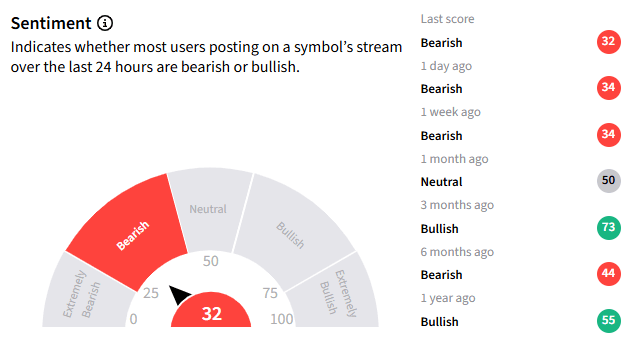
One user said, “$SPY a big issue musk will run into with $TSLA and $SPCX is the end of the inflation debt cycle. When the cycle stops, the spending which produced large industrialization, will be too large to keep going without inflation making debt repayment cheap. The fall will be sharp and these assets will be sold for Pennie’s in the dollar.”
Advertisement|Remove ads.
However, another user said, “$SPCX we are going to wake up to a massive AI breakthrough and this will moon above 200 and everyone will be panicking to buy”
SPCX stock has declined 11% over the past three months.
Advertisement|Remove ads.
For updates and corrections, email newsroom[at]stocktwits[dot]com.
Comments posted here will also appear on symbol pages.

Latest News
/filters:format(webp)https://news.stocktwits-cdn.com/large_Getty_Images_2275136246_jpg_ed278ffb66.webp)
/filters:format(webp)https://news.stocktwits-cdn.com/1707726834303_jpg_11f20a9aa9.webp) Shashank Nayar·15m ago
Shashank Nayar·15m ago/filters:format(webp)https://news.stocktwits-cdn.com/large_Getty_Images_2229072591_jpg_18a80f859a.webp)
/filters:format(webp)https://news.stocktwits-cdn.com/unnamed_jpg_9dff551b50.webp) Anan Ashraf·16m ago
Anan Ashraf·16m ago/filters:format(webp)https://news.stocktwits-cdn.com/large_Getty_Images_2289192410_ae300369d4.jpg) Shashank Nayar·19m ago
Shashank Nayar·19m ago/filters:format(webp)https://news.stocktwits-cdn.com/large_Getty_Images_2167186158_95abd348db.jpg) Anan Ashraf·42m ago
Anan Ashraf·42m ago/filters:format(webp)https://news.stocktwits-cdn.com/large_bank_of_america_ATM_resized_jpg_74da346957.webp) Shashank Nayar·2h ago
Shashank Nayar·2h ago/filters:format(webp)https://news.stocktwits-cdn.com/large_Getty_Images_2208523880_jpg_5bfb5acfa2.webp) Anan Ashraf·3h ago
Anan Ashraf·3h ago