


Advertisement|Remove ads.
USO, UCO Dip As Oil Prices Slide After Trump Declares Iran Deal 'Complete' — Analyst Sees $80 Brent By Year-End
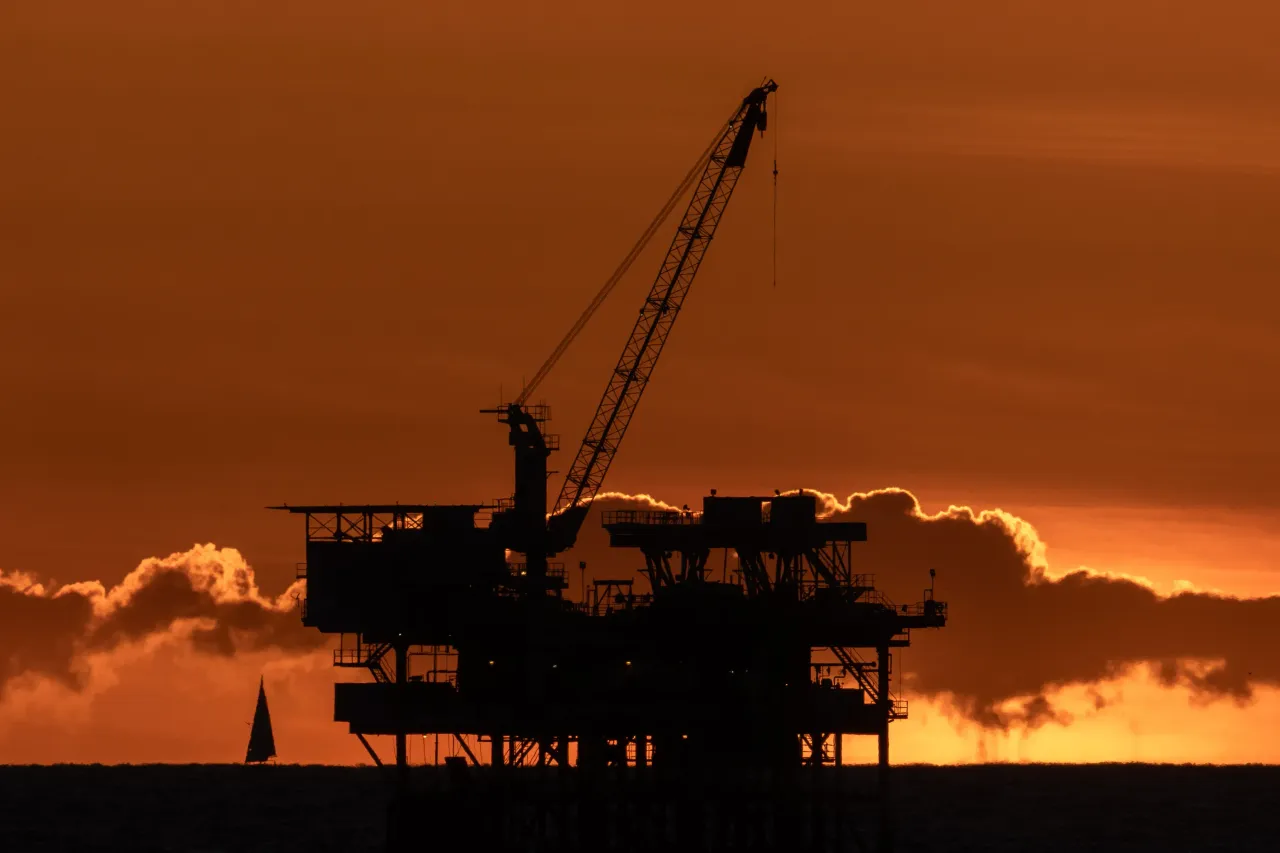


- The official signing ceremony confirming the deal between the U.S. and Iran is expected to be completed in Switzerland on June 19.
- Brent crude futures and WTI crude futures declined about 5% each at the time of writing.
- Meanwhile, Commonwealth Bank of Australia’s Vivek Dhar said that Brent crude oil futures may slump further to around $80 per barrel by the end of the year if the Strait of Hormuz isn’t closed again, as per a report.
Advertisement|Remove ads.
Oil prices declined to their lowest level since March in the overnight session ahead of Monday, dragging down key ETFs linked to the commodity, after the U.S. and Iran reached a deal to end their conflict and reopen the Strait of Hormuz, easing concerns about an energy crunch.
Brent crude futures expiring in August fell 4.47% to trade at around $83.43 a barrel at the time of writing, while WTI crude futures expiring in July declined more than 5% to trade at around $80.60 a barrel.
Meanwhile, Commonwealth Bank of Australia’s Vivek Dhar has said that Brent crude oil futures may slump to around $80 per barrel by the end of the year if the Strait of Hormuz isn’t closed again, according to a report from the Wall Street Journal.
Advertisement|Remove ads.
Trump Announces Deal With Iran
U.S. President Donald Trump confirmed the deal with Iran in a post on Truth Social. “The Deal with the Islamic Republic of Iran is now complete. Congratulations to all!” he said on Sunday.
The president added that the Strait of Hormuz would be open and that “the immediate removal of the United States Naval blockade” would allow ships to pass through the critical waterways. “Ships of the World, start your engines. Let the oil flow!” he said.
In a separate post, Trump also confirmed that the critical Strait would open on Friday following the signing of the deal. “This Great Deal will bring Peace and Security to the whole Region. Many presidents have tried to make Peace with Iran, and all have failed before me. The Leaders of the Region have, for the first time, found a President who can help them achieve real Peace. With the opening of the Strait upon the signing of the Deal on Friday, for purposes of mine removal, oil will flow on both ends again for the Region, and the World!” he said.
Advertisement|Remove ads.
Earlier in the day, Pakistani Prime Minister Shehbaz Sharif confirmed that the official signing ceremony will be completed in Switzerland on June 19.
Where Are Oil Prices Headed?
After the deal announcement, Dhar predicted that oil prices would slip further without additional disruptions to the Strait of Hormuz. “Our forecast implicitly assumes that oil and refined product exports can resume quickly through the Strait of Hormuz,” the analyst reportedly said, noting the interim deal between Iran and the U.S.
“It’s worth noting that oil flows through the Strait of Hormuz just needs to reach 60%-70% of pre-war levels to return oil markets to pre-war oversupply expectations given the oil pipeline bypasses to the strait and non-OPEC+ supply growth this year,” Dhar added.
Advertisement|Remove ads.
Meanwhile, American economist and Professor of Applied Economics at Johns Hopkins University Steve Hanke noted in a post on X that even if the Strait reopened “today without further disruptions,” oil deficits would continue to persist through the last quarter of 2026, citing projections from the International Energy Agency (IEA).
In its latest oil markets report, the IEA predicted worldwide oil production to fall by 3.9 million barrels per day on average in 2026, reducing total supply to 102.2 million barrels per day, after accounting for flows through the Strait of Hormuz, which are expected to recover from June.
“At that point, a small surplus may appear, but rebuilding inventories even to 2025 levels would take at least another year,” Hanke said.
Advertisement|Remove ads.
Oil Market Movement
The United States Oil Fund (USO), an exchange-traded fund (ETF) that tracks the performance of West Texas Intermediate (WTI) light, sweet crude oil, was down nearly 4% in the overnight session on Sunday at the time of writing amid ‘neutral’ retail sentiment.
The Light, Sweet Crude Oil Futures (CL_F) were down about 4.8% amid ‘bullish’ sentiment, and the ProShares Ultra Bloomberg Crude Oil (UCO) fell more than 5% at the time of writing.
Meanwhile, the SPDR S&P 500 ETF (SPY), which tracks the S&P 500, was up more than 1%. The Invesco QQQ Trust (QQQ) and the SPDR Dow Jones Industrial Average ETF Trust (DIA) gained 1.78% and 0.83%, respectively.
Advertisement|Remove ads.
For updates and corrections, email newsroom[at]stocktwits[dot]com.
Comments posted here will also appear on symbol pages.

Latest News
/filters:format(webp)https://news.stocktwits-cdn.com/large_Getty_Images_2213366819_jpg_3e8b649e98.webp)
/filters:format(webp)https://news.stocktwits-cdn.com/Aashika_Suresh_Profile_Picture_jpg_2acd6f446c.webp) Aashika Suresh·2m ago
Aashika Suresh·2m ago/filters:format(webp)https://news.stocktwits-cdn.com/large_vaccine_stocks_947b8b6dd5.jpg)
/filters:format(webp)https://news.stocktwits-cdn.com/IMG_8805_JPG_6768aaedc3.webp) Deepti Sri·15m ago
Deepti Sri·15m ago/filters:format(webp)https://news.stocktwits-cdn.com/large_nvidia_OG_Jun26_860ee43e02.jpg)
/filters:format(webp)https://news.stocktwits-cdn.com/shivani_photo_jpg_dd6e01afa4.webp) Shivani Kumaresan·21m ago
Shivani Kumaresan·21m ago/filters:format(webp)https://news.stocktwits-cdn.com/large_Getty_Images_2282773954_jpg_a026630050.webp)
/filters:format(webp)https://news.stocktwits-cdn.com/IMG_9209_1_d9c1acde92.jpeg) Yuvraj Malik·35m ago
Yuvraj Malik·35m ago/filters:format(webp)https://news.stocktwits-cdn.com/large_spacex_jpg_07ab19438d.webp) Aashika Suresh·1h ago
Aashika Suresh·1h ago/filters:format(webp)https://news.stocktwits-cdn.com/large_Getty_Images_2267646383_8b464ed74a.jpg) Shivani Kumaresan·1h ago
Shivani Kumaresan·1h ago