


Advertisement|Remove ads.
Why SpaceX IPO May Be The Biggest Stress Test Yet For Passive Investing


- Recent rule changes by major indexes, including Nasdaq, FTSE Russell and MSCI will now allow mega-cap IPOs like SpaceX to be added within days of listing.
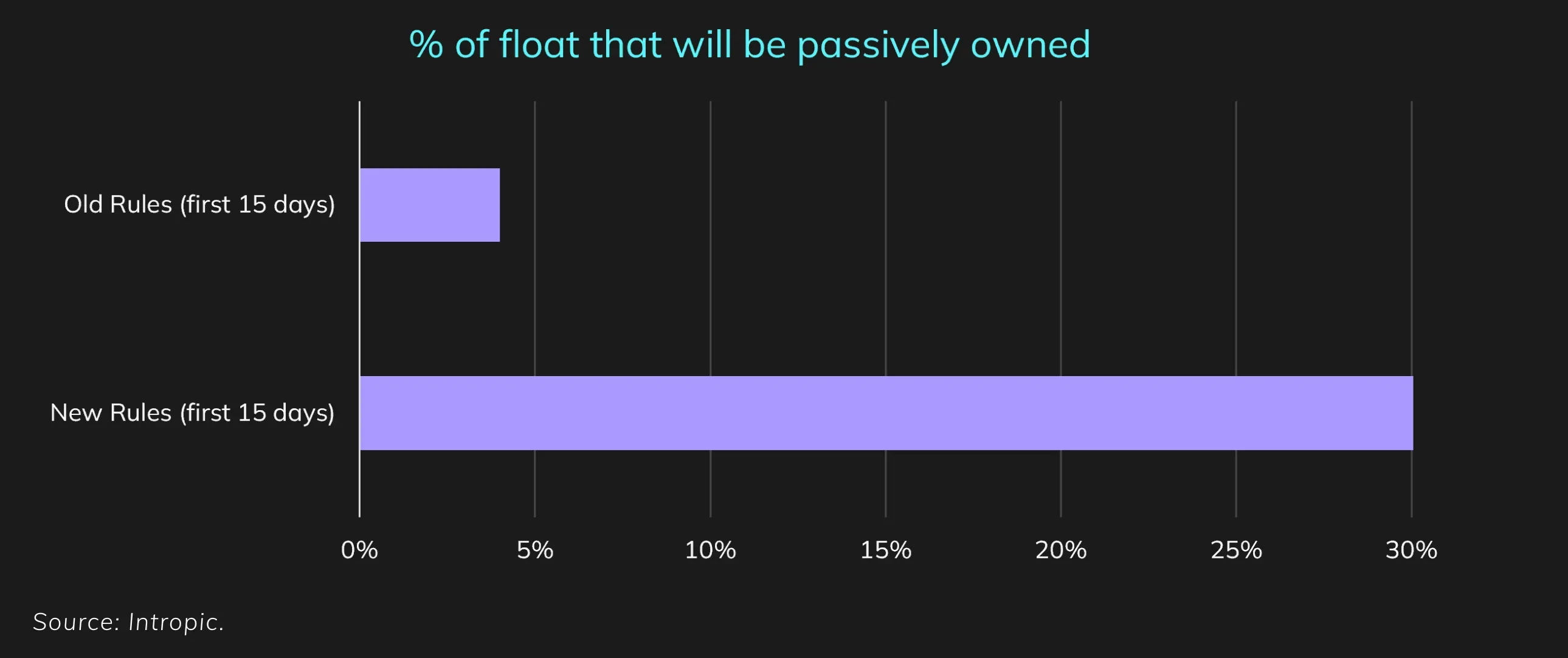
- Research firm Intropic said in a report earlier this week that the new rules could result in passive ownership of SpaceX of nearly 30% within the first 15 days of trading.
- Veteran investor George Noble argued that SpaceX's upcoming inclusion in major indexes could trigger an estimated $22 billion to $27 billion in passive fund buying, which he says will be a key driver of the stock's short-term bull case.
Advertisement|Remove ads.
It's all about SpaceX on Wall Street this week. The Elon Musk-led rocket maker's historic initial public offering, at a whopping $1.77 trillion valuation, has generated enormous buzz and intense debate over a valuation pegged to extremely ambitious long-term goals. Yet even as most of the attention centers on the company's scale and growing retail excitement, some experts are raising a quieter concern: the mechanics of forced index-fund buying.
Recent rule changes by major index providers, including Nasdaq, FTSE Russell, and MSCI, now allow mega-cap IPOs like SpaceX to be added to their indexes within days of listing, dramatically accelerating passive fund inflows.
“They have to buy the stocks that are in the index in proportion to their weighting within the index,” Aleksander Tomic, associate dean for strategy, innovation and technology at Boston College, reportedly told Al Jazeera about the purchase of mega companies following their public debut.
Advertisement|Remove ads.
“As a result, they will all be forced to buy these companies immediately, and that could be highly undesirable,” he added.
How Will SpaceX IPO Affect Passive Funds?
Earlier this year, Nasdaq introduced changes that would allow mega-cap companies to join the Nasdaq-100 index just 15 days after their public market debuts. Previously, newly public companies were required to wait at least three months. Meanwhile, FTSE Russell’s changed rules now permit inclusion after just five trading days.
Research firm Intropic said in a report earlier this week that the new rules could increase passive ownership of SpaceX from roughly 4% of free float under previous rules to nearly 30% within the first 15 days of trading. The firm expects demand from index-tracking funds to be heavily concentrated during the first three weeks after the IPO.
Advertisement|Remove ads.
This means that millions of retirement accounts, pension funds, and university endowments tied to passive investment vehicles that track major indexes will be forced to buy the stock.
"If SpaceX enters the Nasdaq, these fund managers can't simply choose not to track it because they are contractually obligated to follow the index," Colin Clark, lead adviser and director of business analytics at Northwestern Mutual, told Al Jazeera.
SpaceX IPO: Impact On Prices
Meanwhile, Marco Sammon, an assistant professor at Harvard Business School who has studied the impact of passive investing, told Bloomberg that fast-tracking IPOs into indexes could also impact prices, temporarily inflating them and increasing the risk of losses when those gains fade.
Advertisement|Remove ads.
“When the window is compressed, the same amount of mechanical demand is more likely to generate relatively more temporary price impact and subsequent reversal,” Sammon said to Bloomberg. “This is compounded by the post-IPO market being generally volatile and illiquid. In such cases, the cost for index fund investors will be larger.”
Tomic also warned about the significant overvaluation of these new IPOs. “What’s particularly problematic is the 15-day rule because there isn’t enough time to see how an IPO will perform,” Tomic reportedly said.
Intropic also emphasized that retail investor participation, passive demand expectations, and reflexivity among options market makers could drive prices upward, regardless of fundamentals.
Veteran investor George Noble, who worked with the legendary Peter Lynch, argued that his mentor would “have HATED everything about this SpaceX IPO.”
Advertisement|Remove ads.
"Long shots almost never pay off. Peter spent his entire career proving this. He made his money on Dunkin' Donuts, Taco Bell, Hanes, Chrysler - businesses you could walk into, understand in 30 seconds, and value off a napkin. He avoided the hot moonshot stocks of his era because the math never worked," said Noble, in a post on X.
"SpaceX is one GIANT long shot. Starship has to work at scale, Starlink margins have to hold as the satellite competition floods in, xAI has to catch OpenAI and Anthropic in a race it is currently losing, Mars has to generate returns inside our lifetimes. Every one of those is a coin flip. But the $1.77 trillion price tag assumes ALL FOUR are near-certainties," he added.
SpaceX's upcoming inclusion in major indexes could trigger an estimated $22 billion to $27 billion in passive fund buying, Noble said, adding that it will be a key driver of the stock's short-term bull case. “The smart money is NOT buying SpaceX today.”
Advertisement|Remove ads.
SPCX IPO: What’s Retail Saying?
On Stocktwits, retail chatter around the SPCX ticker has surged 663% in the past 24 hours and a whopping 9,194.1% in the past month.
While the IPO is priced at $135 per share, investors are eyeing a massive jump, with one predicting it to surge to $250.
Advertisement|Remove ads.
Another user said, “Prepare for liftoff tomorrow!!”
Retail sentiment around SPCX has stayed in the “extremely bullish” territory over the past week.
Advertisement|Remove ads.
According to Koyfin data, two analysts already hold a ‘Buy’ rating on SPCX, with their consensus price target implying that the stock is already trading at about a 3% discount to fair value.
For updates and corrections, email newsroom[at]stocktwits[dot]com.
Comments posted here will also appear on symbol pages.

Latest News
/filters:format(webp)https://news.stocktwits-cdn.com/large_Getty_Images_2188532140_jpg_1eb152a875.webp)
/filters:format(webp)https://news.stocktwits-cdn.com/Anushka_Basu_make_me_smile_in_the_picture_b92832aa_af59_4141_aacc_4180d2241ba8_1_2_png_1086e0ed8c.webp) Anushka Basu·4h ago
Anushka Basu·4h ago/filters:format(webp)https://news.stocktwits-cdn.com/large_Getty_Images_2290360640_1ec7422bc6.jpg) Anushka Basu·5h ago
Anushka Basu·5h ago/filters:format(webp)https://news.stocktwits-cdn.com/large_Getty_Images_2184298752_597d0bfcd2.jpg) Anushka Basu·7h ago
Anushka Basu·7h ago/filters:format(webp)https://st-everywhere-cms-prod.s3.us-east-1.amazonaws.com/large_charles_schwab_resized_79fd4282b7.jpg) Anushka Basu·9h ago
Anushka Basu·9h ago/filters:format(webp)https://news.stocktwits-cdn.com/large_Getty_Images_1236413131_82e1a6f16e.jpg) Anushka Basu·10h ago
Anushka Basu·10h ago/filters:format(webp)https://news.stocktwits-cdn.com/large_Getty_Images_2255514431_jpg_95e96b4025.webp)
/filters:format(webp)https://st-everywhere-cms-prod.s3.us-east-1.amazonaws.com/i_OS_App_Icon_1_8054f2a2fe.png) Stocktwits News Desk·10h ago
Stocktwits News Desk·10h ago