


Advertisement|Remove ads.
Crypto Market Falls Ahead Of High-Stakes CLARITY Act Markup, Bitcoin Falls Below $80K



- Solana and Ethereum led declines among major cryptocurrencies, falling more than Bitcoin in the last 24 hours.
- Analysts said hotter-than-expected inflation data added pressure across cryptocurrency markets this week.
- Traders are closely watching whether the Senate crypto bill can secure bipartisan support and advance further.
Advertisement|Remove ads.
Bitcoin (BTC) and the broader cryptocurrency market moved lower Thursday morning ahead of the Senate Banking Committee’s CLARITY Act markup later in the day, with retail traders closely watching whether the legislation can gain enough bipartisan support to advance.
Bitcoin’s price fell 1.5% in the last 24 hours to around $79,200. Retail sentiment around the apex cryptocurrency on Stocktwits trended in ‘neutral’ territory over the past day, accompanied by ‘normal’ levels of chatter.


Retail traders on the platform were focused on the Senate’s debate over the CLARITY Act. A poll on Stocktwits showed that most believe that the bill will pass both houses, however 30% opined that “nothing meaningful” will come of it in 2026.
Advertisement|Remove ads.
Solana (SOL) and Ethereum (ETH) led losses among the top 10 cryptocurrencies by market capitalization. Solana’s price fell 3.8% to around just above $90. Ethereum’s price fell 2% to under $2,300.
Advertisement|Remove ads.
Why Did Bitcoin Crash?
Market analysts pointed to a combination of macroeconomic pressure, weakening on-chain flows and aggressive leverage positioning behind Bitcoin’s decline.
According to a CryptoQuant analyst, exchange outflows slowed down in recent days while inflows remained steady, causing netflows to turn positive. They said the shift suggested growing sell-side liquidity on exchanges and weaker demand momentum. Data from Farside Investors showed, spot BTC ETFs saw their largest single day of net outflows since January on Wednesday amounting to $630.4 million.
The analyst also noted that the derivatives markets showed elevated short positioning ahead of key inflation reports. Open interest climbed between May 8 and May 10 while funding rates stayed negative, signaling traders were increasingly betting on downside pressure.
Advertisement|Remove ads.
When inflation data came in hotter than expected, long positions were hit hard. The analyst estimated that nearly $110 million in long positions were liquidated between May 11 and May 13, amplifying Bitcoin’s decline.
“If Bitcoin reclaims the $80,000 level, it could rally towards the $82,000 zone again,” said crypto analyst Ted Pillows in a post on X.
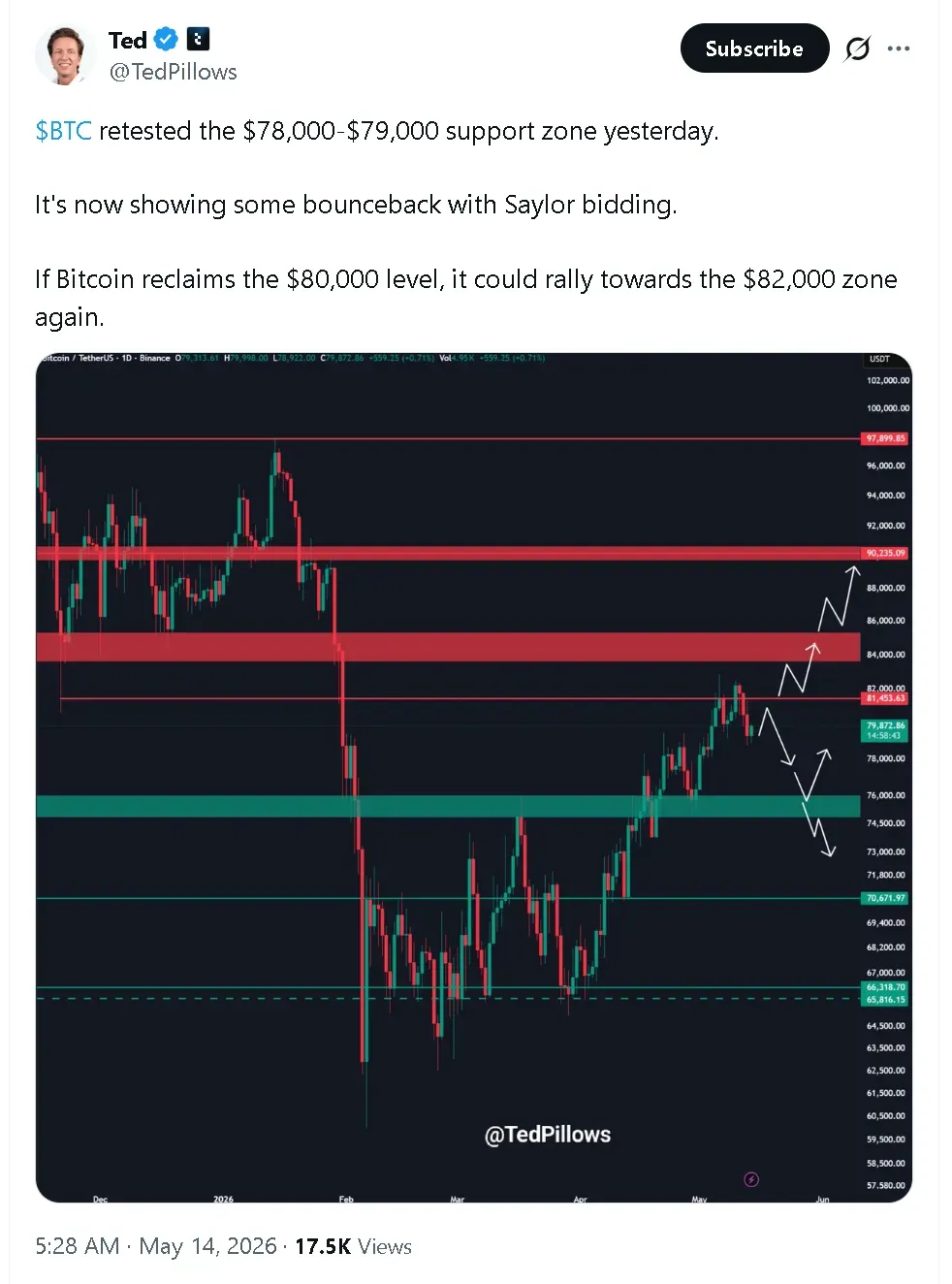
BTC’s price has fallen nearly 10% this year and is down 23% in the last 12 months. It remains nearly 40% below its record high of over $26,000 seen in October.
Advertisement|Remove ads.
Crypto Slides Ahead Of Senate CLARITY Act Markup
The Republican-led Senate Banking Committee is scheduled to hold its markup session on Thursday morning, where lawmakers will debate amendments and vote on whether to advance the legislation. The bill has been stuck in limbo since January with crypto companies and banks debating stablecoin yield.
The legislation seeks to clarify regulatory oversight of cryptocurrencies, particularly the division of authority between the Securities and Exchange Commission (SEC) and the Commodity Futures Trading Commission (CFTC). The latest draft also includes developer protections and a $10 billion cap on stablecoin issuers.
The draft also included a surprise section in the form of the Build Now Act in Section 904, a pilot program that rewards cities and counties exceeding median housing growth rates with extra Community Development Block Grant funding, while cutting funds for slower performers.
Advertisement|Remove ads.
What it does not include, and could be a sticking point with the democrats, is an ethics restrictions on federal officials profiting from crypto ventures while in office.
Read also: Bitcoin Slips Below $80K After PPI Data Triples Forecast, Adding To Inflation Fears
For updates and corrections, email newsroom[at]stocktwits[dot]com
Advertisement|Remove ads.
Comments posted here will also appear on symbol pages.

Latest News
/filters:format(webp)https://news.stocktwits-cdn.com/large_amzn_gsat_6c81fe2339.jpg)
/filters:format(webp)https://news.stocktwits-cdn.com/IMG_8805_JPG_6768aaedc3.webp) Deepti Sri·20m ago
Deepti Sri·20m ago/filters:format(webp)https://news.stocktwits-cdn.com/large_Getty_Images_1233526690_aefd63f087.jpg)
/filters:format(webp)https://news.stocktwits-cdn.com/shivani_photo_jpg_dd6e01afa4.webp) Shivani Kumaresan·22m ago
Shivani Kumaresan·22m ago/filters:format(webp)https://news.stocktwits-cdn.com/large_Getty_Images_2227231546_jpg_166eaa38da.webp)
/filters:format(webp)https://news.stocktwits-cdn.com/Aashika_Suresh_Profile_Picture_jpg_2acd6f446c.webp) Aashika Suresh·37m ago
Aashika Suresh·37m ago/filters:format(webp)https://news.stocktwits-cdn.com/large_Getty_Images_2294813618_32d1c72fa2.jpg) Aashika Suresh·1h ago
Aashika Suresh·1h ago/filters:format(webp)https://news.stocktwits-cdn.com/large_michael_burry_cropped_b787ce89b4.jpg)
/filters:format(webp)https://news.stocktwits-cdn.com/1707726834303_jpg_11f20a9aa9.webp) Shashank Nayar·2h ago
Shashank Nayar·2h ago/filters:format(webp)https://news.stocktwits-cdn.com/gettyimages_2267701500_594x594_1cfbb8b517.jpg) Shashank Nayar·2h ago
Shashank Nayar·2h ago