


Advertisement|Remove ads.
Michael Saylor Downplays BIP 110 Spam Filter Debate, Calls Consensus Change Precedent The Real Risk To Bitcoin
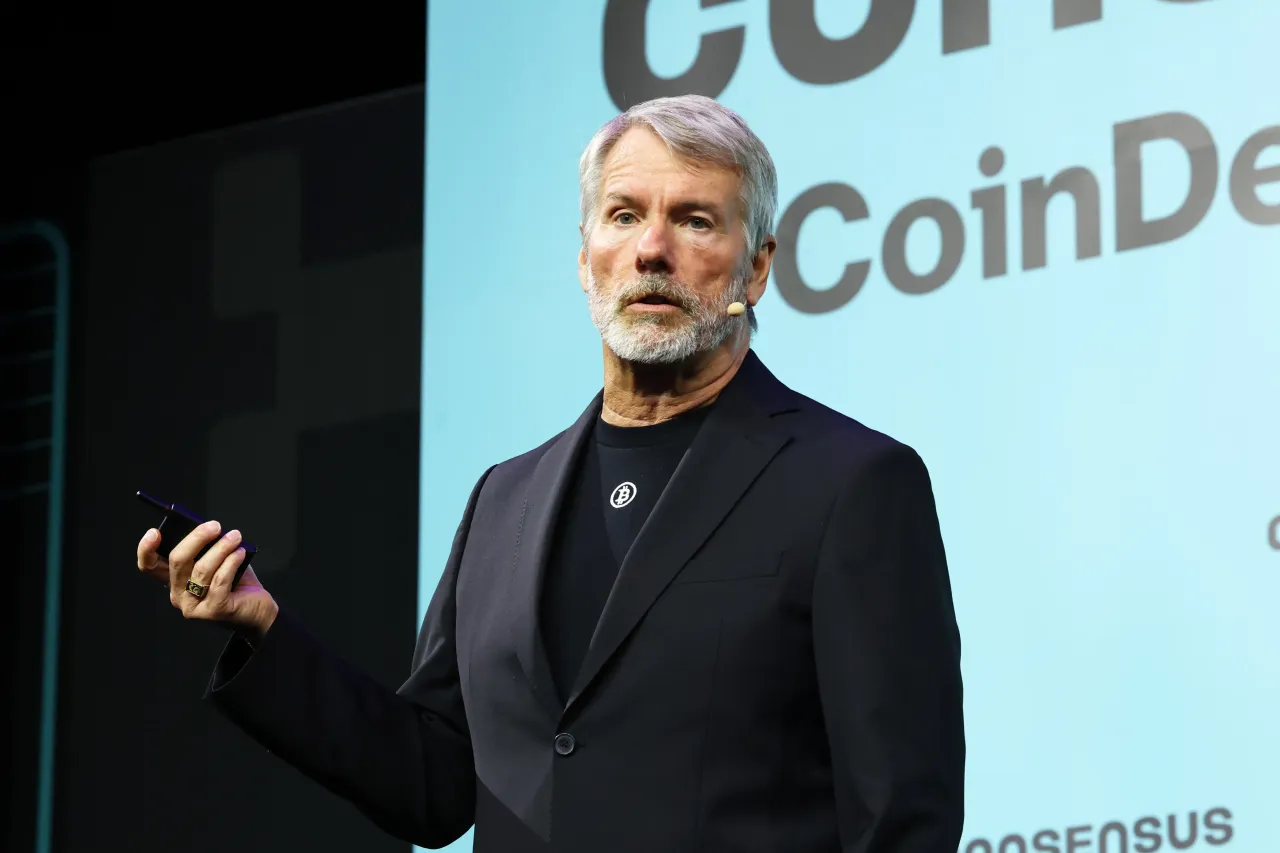


- Michael Saylor expressed concerns that Bitcoin faces greater risks from BIP 110 than from spam.
- He warned that BIP 110 could potentially invalidate valid, fee-paying transactions.
- Saylor's remarks were a response to a discussion initiated by Bitcoin developer Adam Back regarding the "filter fork" debate.
- Technical objections have been raised by Bitcoin Core developer Greg Maxwell and developer Peter Todd, including risks posed by pre-signed transactions and reliance on a UASF activation path rather than majority miner consensus.
Advertisement|Remove ads.
Bitcoin (BTC) is less threatened by the ongoing spam filter debate than by the precedent set by a proposed rule change, Michael Saylor, executive chairman of Strategy (MSTR), said Sunday.
BIP 110, Saylor said, would turn what he called a spam dispute into a consensus-level change that could invalidate transactions that are valid and paying fees today. Instead of spam itself, he said, the greater threat was the shift in precedent, and he urged the community to focus on more pressing issues. "There are 110 things more dangerous to Bitcoin than spam," Saylor wrote in a post on X.
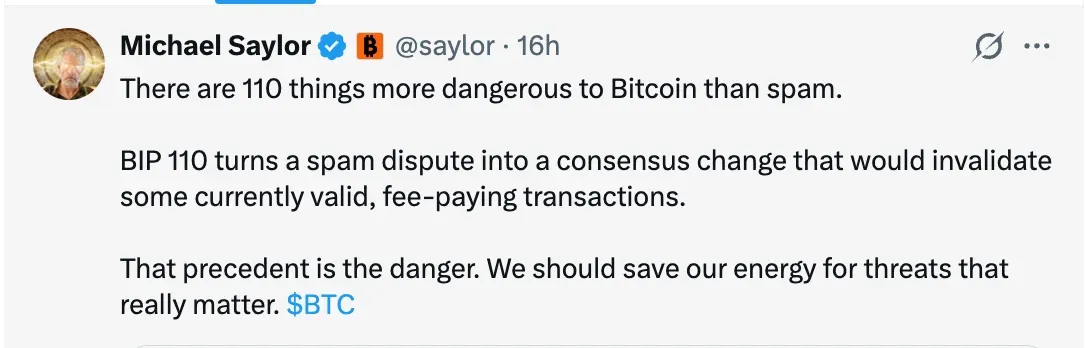
Saylor’s post was a response to a thread from Bitcoin developer and cypherpunk Adam Back, who said he had listened to Twitter Spaces discussions earlier in the week involving what he described as “well-meaning relative bitcoin newcomers” discussing the filter fork topic.
Advertisement|Remove ads.
Why Does BIP 110 Remain Deeply Contested?
BIP 110 is a proposal to change the rules of Bitcoin so that the amount of additional non-money-related data one can add to transactions, such as images or text, is limited. It is controversial for a number of reasons: the proposer is using a pseudonym; critics suspect it is secretly funded by a mining company trying to hide its involvement; almost no Bitcoin miners support it; and even Bitcoin's own rule-review process has called it reckless.
Technical critics have pointed out that the limits could be easily circumvented and might inadvertently break some already-valid transactions. And because supporters are trying to push it through even without broad support, there’s a real danger it could split Bitcoin into two competing versions of the currency. So the fight is not really about spam -- it's about whether a small group, with little support, should be able to impose a major rule change on the whole network.
Criticism From Veteran Bitcoin Developers
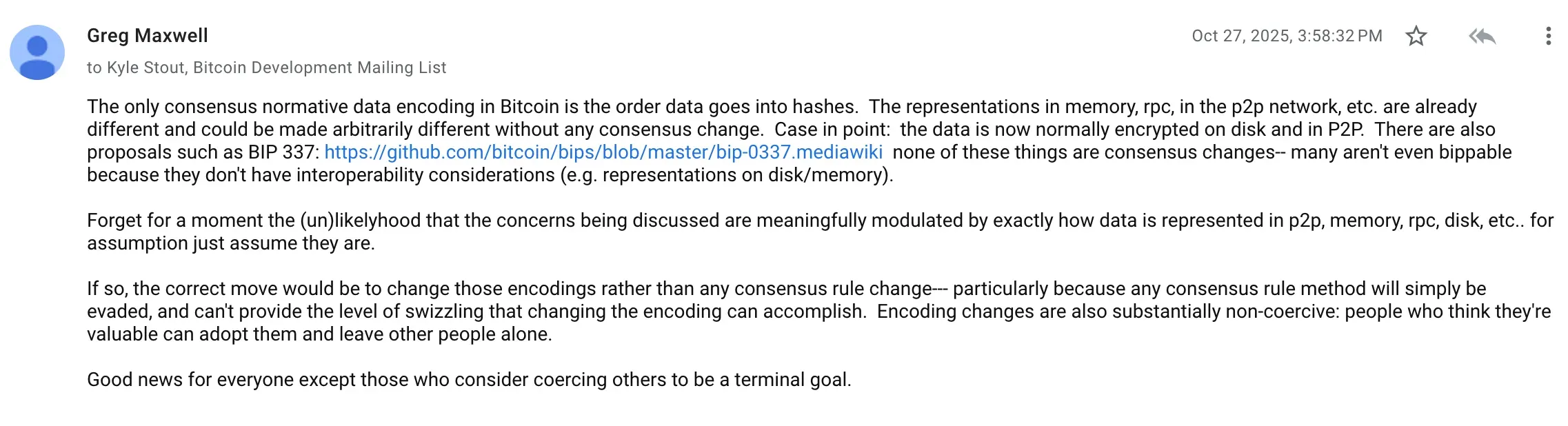
Bitcoin Core developer Greg Maxwell once warned on the bitcoin-dev mailing list that BIP 110 could invalidate legitimate pre-signed or time-locked transactions created before the fork.
Advertisement|Remove ads.
“Forget for a moment the (un) likelihood that the concerns being discussed are meaningfully modulated by exactly how data is represented in p2p, memory, rpc, disk, etc.. for assumption just assume they are,” wrote Maxwell.
Developer Peter Todd embedded a transaction that complies with this specification to verify that this provision did not block on-chain storage. Todd had put forward four technical criticisms of the blockchain upgrade proposal BIP 110.
He said the proposal ignores the high probability that Bitcoin will split into two competing chains; it adopts the User Activated Soft Fork (UASF) activation standard instead of BIP-65’s 95% miner threshold activation rule, which reveals that it cannot secure support from a majority of miners; it fails to address the issue of how wallet addresses should respond to chain splits; and its complete lack of a timeline for its miner activation mechanism is entirely absurd.
Advertisement|Remove ads.
Read also: Arthur Hayes Predicts $1M For Bitcoin And Warns AI Bubble Is 'Bigger Than Subprime’
For updates and corrections, email newsroom[at]stocktwits[dot]com
Comments posted here will also appear on symbol pages.

Latest News
/filters:format(webp)https://news.stocktwits-cdn.com/large_cathiewood_OG_jpg_a3c8fddb3f.webp)
/filters:format(webp)https://st-everywhere-cms-prod.s3.us-east-1.amazonaws.com/i_OS_App_Icon_1_8054f2a2fe.png) Stocktwits News Desk·1h ago
Stocktwits News Desk·1h ago/filters:format(webp)https://news.stocktwits-cdn.com/Getty_Images_2237643016_jpg_17a9a7eb9d.webp) Stocktwits News Desk·3h ago
Stocktwits News Desk·3h ago/filters:format(webp)https://news.stocktwits-cdn.com/large_trump_putin_jpg_eb42a46830.webp) Stocktwits News Desk·3h ago
Stocktwits News Desk·3h ago/filters:format(webp)https://news.stocktwits-cdn.com/large_Getty_Images_2286326398_84fc8215c8.jpg)
/filters:format(webp)https://news.stocktwits-cdn.com/Prabhjote_DP_67623a9828.jpg) Prabhjote Gill·4h ago
Prabhjote Gill·4h ago/filters:format(webp)https://news.stocktwits-cdn.com/large_Getty_Images_2162497795_jpg_c07f3aa255.webp)
/filters:format(webp)https://news.stocktwits-cdn.com/vivekkrishnanphotography_58_jpg_0e45f66a62.webp) Arnab Paul·5h ago
Arnab Paul·5h ago/filters:format(webp)https://news.stocktwits-cdn.com/large_Getty_Images_2250139725_0ccee3701a.jpg)
/filters:format(webp)https://news.stocktwits-cdn.com/unnamed_jpg_9dff551b50.webp) Anan Ashraf·6h ago
Anan Ashraf·6h ago