


Advertisement|Remove ads.
STRK Token Outperforms Bitcoin To Hit 9-Month High After Starknet Says It Is ‘Actively Considering’ Layer-1 Shift



- The proposed shift would move Starknet beyond its current role as an Ethereum Layer 2, potentially giving it more control over its technology and security.
- Starknet’s v0.14.4 upgrade went live on mainnet on Monday, updating gas pricing and gateway APIs and adding support for larger proofs through SNIP-36.
- The network’s quantum-resistance target remains a work in progress, with Starknet yet to confirm a Layer 1 transition or provide a detailed implementation plan.
Advertisement|Remove ads.
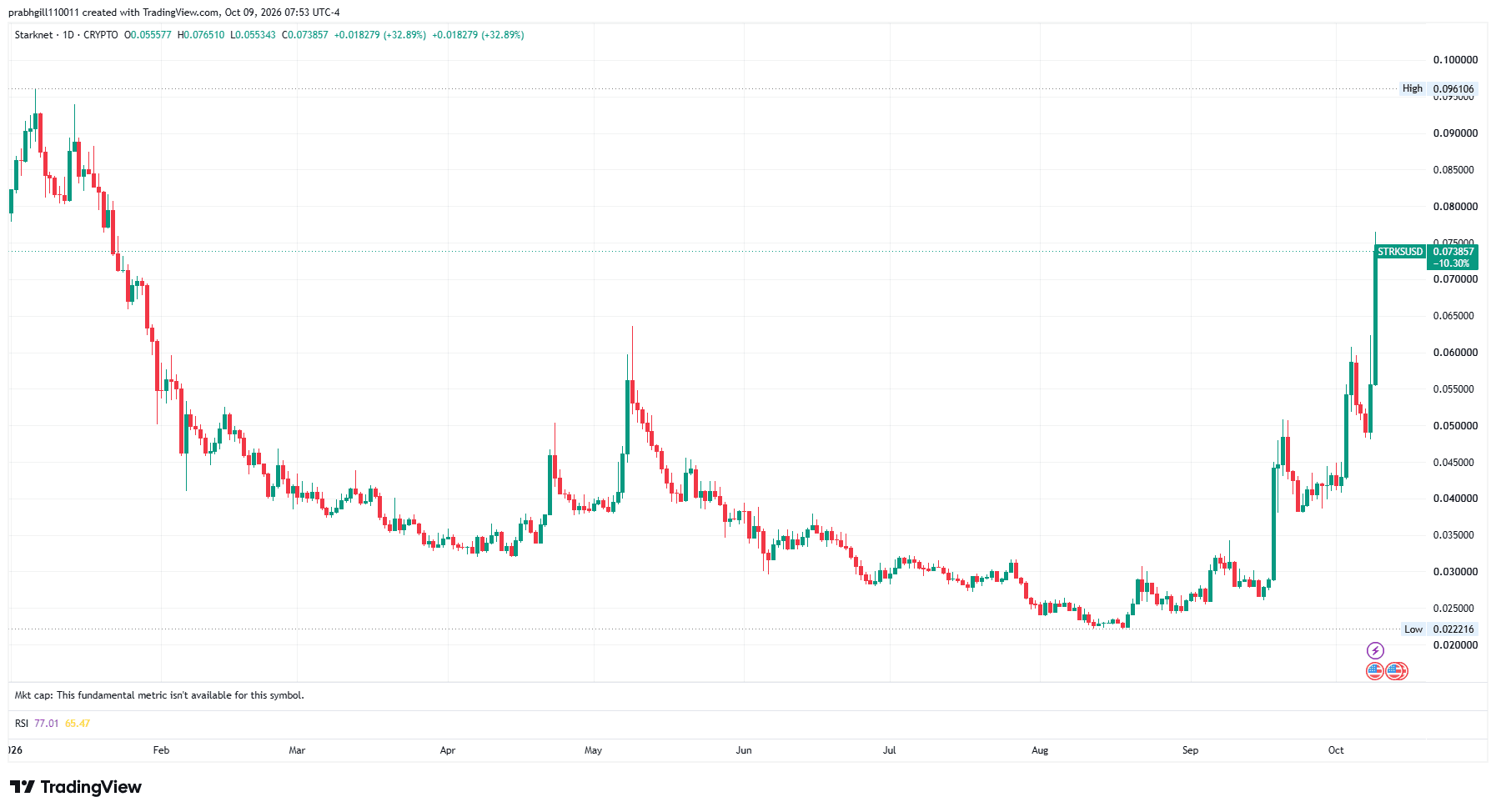
Starknet’s (STRK) token rallied on Friday morning, outperforming Bitcoin (BTC) and climbing to a nine-month high in its biggest single-day gain in over a year after the network said it was considering becoming a Layer 1 blockchain to accelerate its push toward quantum resistance.
“We are actively considering becoming an L1,” Starknet said in a post on X. “This would enable Starknet to become the first fully quantum-resistant network, with 2027 as our target.”
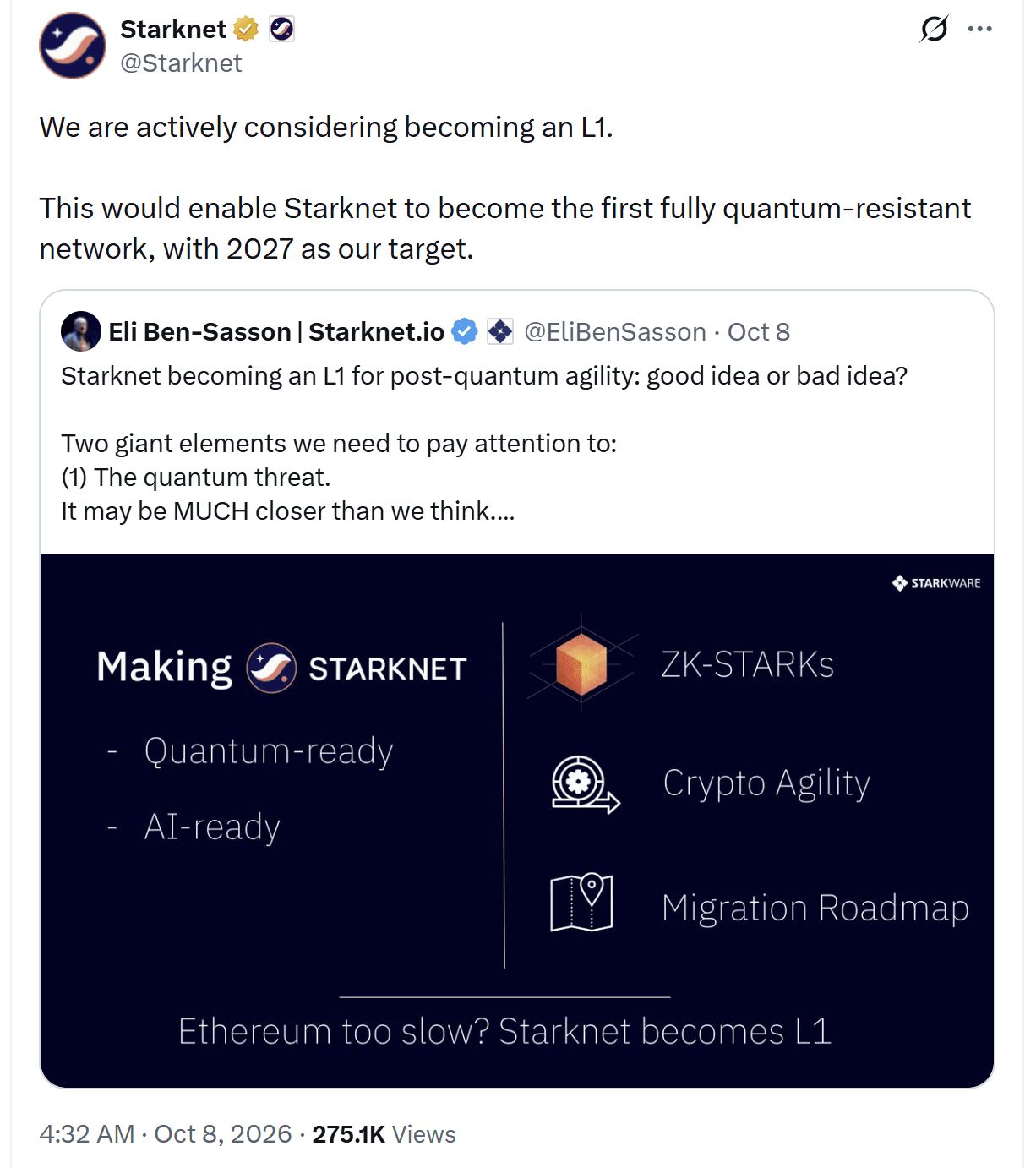
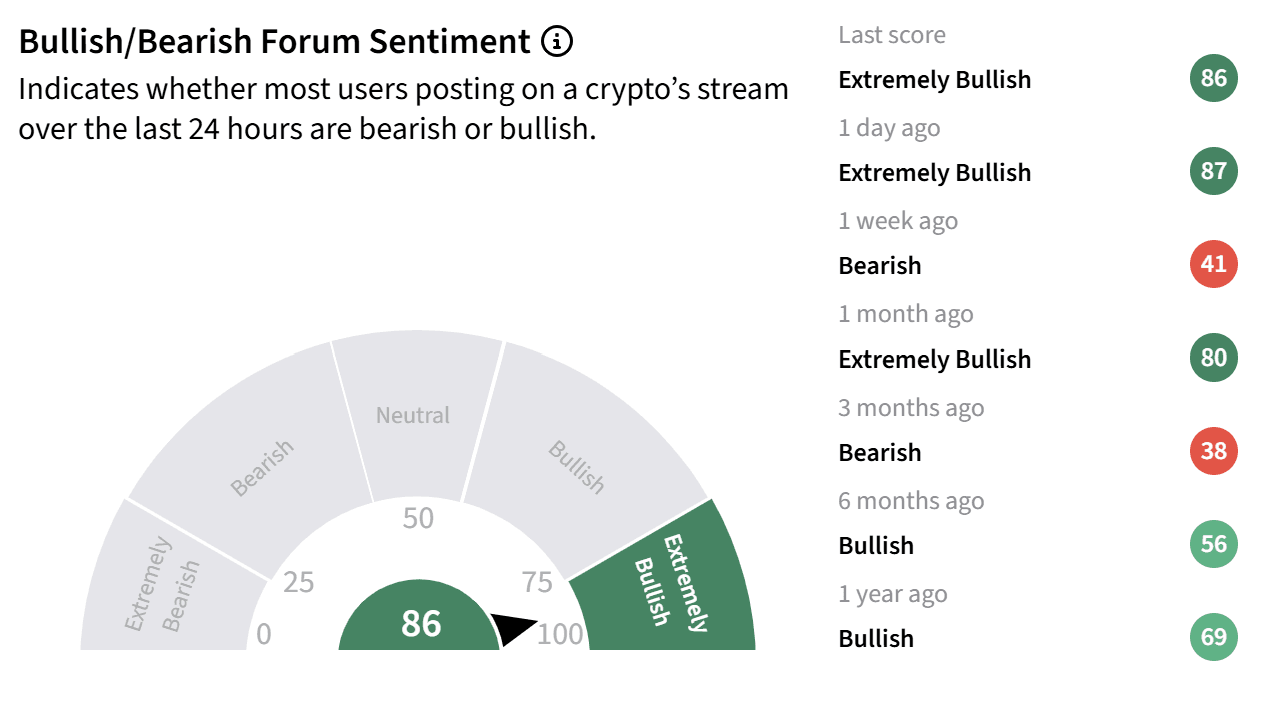
STRK token rallied more than 30% in the last 24 hours to over $0.07 and was among the top trending tickers on Stocktwits at the time of writing. Retail sentiment around STRK on the platform trended in ‘extremely bullish’ territory over the past day.
Advertisement|Remove ads.
STRK token’s move came against a weaker backdrop for digital assets. Bitcoin’s price traded around $82,400 after recovering from a drop below $81,000 in the previous session. The selloff triggered more than $1 billion in crypto liquidations over 24 hours, as leveraged positions were forcibly closed across the market.
Starknet Weighs Moving Beyond Ethereum
The network currently operates as a Layer 2 on Ethereum, but becoming a Layer 1 could give it greater control over its protocol and the cryptographic components needed to prepare for future quantum-computing threats.
The proposal remains under consideration, with technical details and a formal transition plan yet to be established.
Advertisement|Remove ads.
Quantum Resistance Builds On Starknet’s Existing Roadmap
Starknet’s quantum-resistance push builds on technology it already uses. Its STARK proofs allow the network to verify complex computations without having to repeat all the underlying work.
The system relies on cryptographic methods designed to offer stronger protection against quantum-computing threats than some widely used alternatives.
However, that does not mean Starknet is already fully quantum-resistant. Protecting an entire blockchain requires reviewing multiple components, including the methods used to verify transactions and secure accounts, as well as the network’s links to other blockchains.
Advertisement|Remove ads.
Starknet’s 2027 target therefore represents a goal for completing that work, not a guarantee that all potential vulnerabilities will be eliminated by then.
Starknet Upgrade Adds Support For Larger Proofs
The announcement also follows a technical upgrade. Starknet v0.14.4 went live on mainnet on Monday, updating gas pricing and gateway APIs while introducing support for larger proofs through SNIP-36.
In simple terms, proofs allow applications to demonstrate that complex computations were completed correctly without requiring the network to repeat every step. Supporting larger proofs could allow developers to run more complex applications on Starknet.
Advertisement|Remove ads.
The upgrade also changes how the network accounts for the resources transactions consume, helping gas costs better reflect the work required to process them. Node operators and SNIP-36 provers must upgrade to remain compatible with the new version.
Starknet’s ambitions also extend beyond scaling Ethereum. The project has been working on bringing Bitcoin-related applications and decentralized finance services to its network, including strkBTC, a Bitcoin-backed asset.
Advertisement|Remove ads.
For updates and corrections, email newsroom[at]stocktwits[dot]com.
Comments posted here will also appear on symbol pages.

Latest News
/filters:format(webp)https://news.stocktwits-cdn.com/large_Getty_Images_2289079202_89814720c2.jpg)
/filters:format(webp)https://news.stocktwits-cdn.com/vivekkrishnanphotography_58_jpg_0e45f66a62.webp) Arnab Paul·23 seconds ago
Arnab Paul·23 seconds ago/filters:format(webp)https://st-everywhere-cms-prod.s3.us-east-1.amazonaws.com/large_Crowdstrike_logo_resized_cce5c5379f.jpg)
/filters:format(webp)https://news.stocktwits-cdn.com/Prabhjote_DP_67623a9828.jpg) Prabhjote Gill·14m ago
Prabhjote Gill·14m ago/filters:format(webp)https://news.stocktwits-cdn.com/large_cryptocurrency_generic_jpg_4184e1dbd8.webp) Prabhjote Gill·1h ago
Prabhjote Gill·1h ago/filters:format(webp)https://news.stocktwits-cdn.com/gettyimages_110501014_594x594_282a05fbb6.jpg)
/filters:format(webp)https://news.stocktwits-cdn.com/Harshita_3cfe02022c.jpg) Harshita Tyagi·1h ago
Harshita Tyagi·1h ago/filters:format(webp)https://news.stocktwits-cdn.com/large_humana_resized_jpg_e2c016ee03.webp)
/filters:format(webp)https://news.stocktwits-cdn.com/Heera_1_1c30cb0170.PNG) Heera Hari·1h ago
Heera Hari·1h ago/filters:format(webp)https://st-everywhere-cms-prod.s3.us-east-1.amazonaws.com/large_cvs_health_pharmacy_store_sign_58669f89b6.jpg) Arnab Paul·1h ago
Arnab Paul·1h ago