


Advertisement|Remove ads.
‘Big Short’ Investor Michael Burry Flags Trump’s Market ‘Misdirection’ But Says Earnings Still Rule
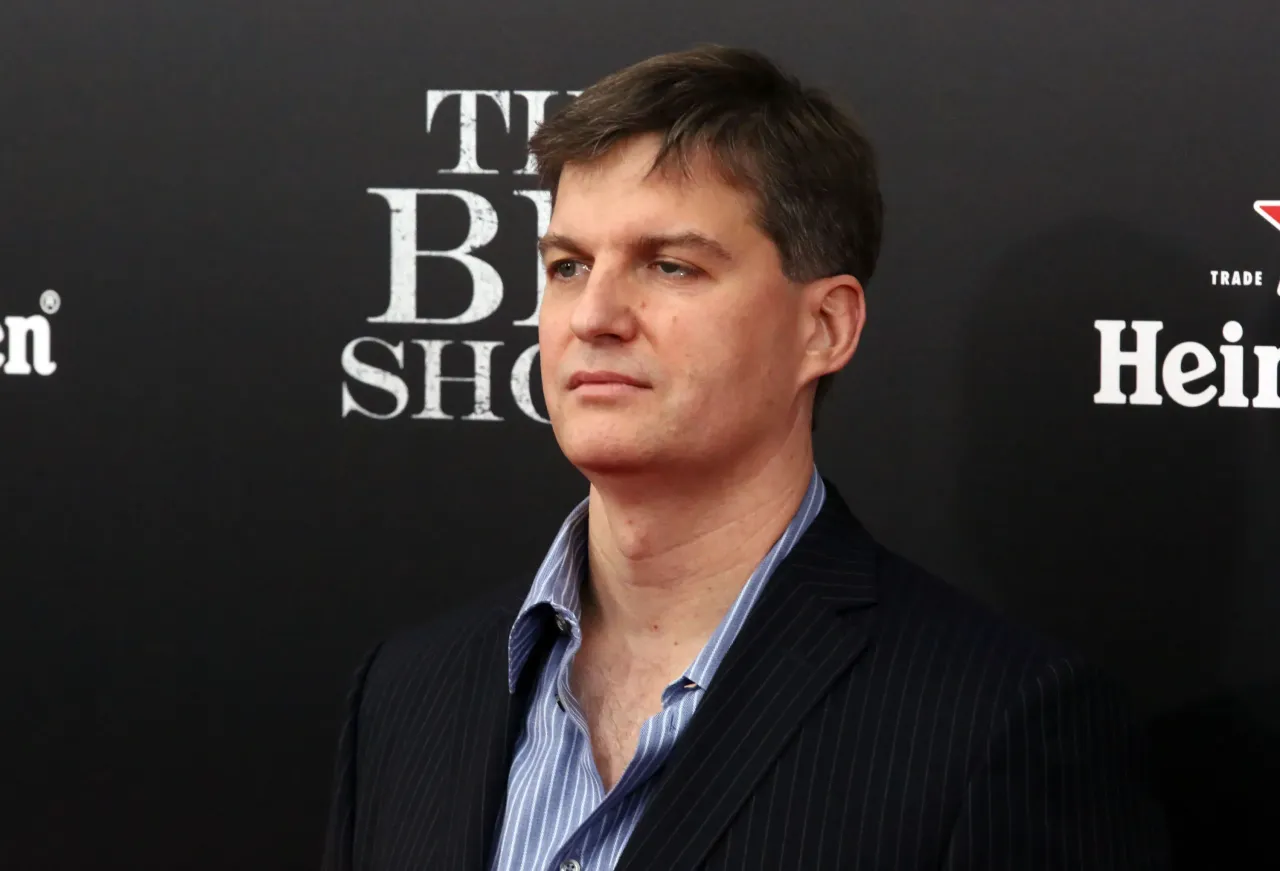


- Burry said that Trump “has found an interesting way to change the subject when markets get a little too bearish.”
- In a separate Substack post, Burry said that the market’s rally is unlikely to be followed by a sudden crash.
- The investor also reiterated his position in payments and software stocks, including PayPal, Fiserv, Adobe, and Salesforce.
Advertisement|Remove ads.
“The Big Short” investor Michael Burry, who famously predicted the subprime mortgage crisis, has alleged that U.S. President Donald Trump finds ways to distract from the market when market signals turn bearish, but has reiterated that companies’ earnings would play a bigger role.
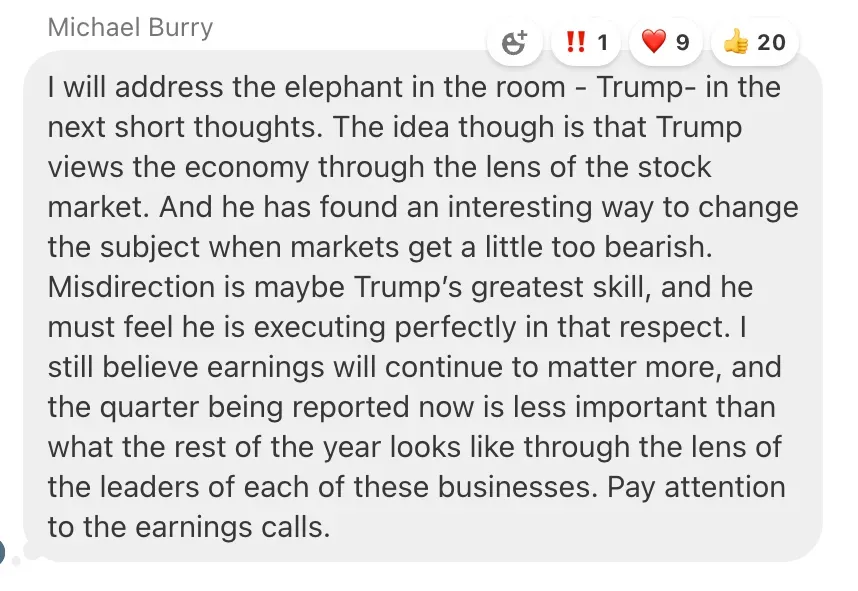
In a Substack chatroom with subscribers, Burry addressed “the elephant in the room,” that is, the impact of Trump’s war on Iran. “The idea though is that Trump views the economy through the lens of the stock market,” he wrote, adding that Trump “has found an interesting way to change the subject when markets get a little too bearish. Misdirection is maybe Trump’s greatest skill, and he must feel he is executing perfectly in that respect.”
Most recently, U.S. stock markets notched record highs on Wednesday following two straight days of declines after the president extended a ceasefire with Iran, sending the S&P 500 to a record high of 7,137.90 at close, and the Nasdaq Composite to 24,657.57.
Advertisement|Remove ads.
Burry’s Bet On Companies
Meanwhile, the legendary investor is urging markets to pay closer attention to earnings results. “I still believe earnings will continue to matter more, and the quarter being reported now is less important than what the rest of the year looks like through the lens of the leaders of each of these businesses. Pay attention to the earnings calls,” he said in the comment.
Multiple big-league companies reported earnings this week, with Tesla, Boeing, IBM, ServiceNow, and Molina Healthcare posting results on Wednesday.
MOH shares gained after the company posted first-quarter (Q1) results. Burry said that he plans to add more shares at current levels. “This thesis is not about this year, though. It is about a return to $20+ earnings in a couple of years. I have not sold a share, and I plan to add shares in the morning,” he said.
Advertisement|Remove ads.
The investor also commented on NOW shares that plummeted after posting lackluster results. “Wonder if $NOW is the first to blame the Iran War or the first victim of the Iran war,” he said, adding that the company’s expansion rate would have likely been higher if not for the war’s impact.
Burry Says Markets Unlikely To Crash
In a separate Substack post, Burry said that the market’s rally is unlikely to be followed by a sudden “needle top” crash. “The easiest path has been up since the new highs. It may take a few months or into the heat of election season for stocks to get that new top in,” he said.
A needle top in markets is a price chart pattern in which an asset records a sharp upward spike, followed closely by an equally swift and steep crash. “This is not to discount volatility. In fact, I can only imagine with elections and geopolitical quagmires, volatility is on tap. But I doubt we will see the inaugural major U.S. market needle top,” he said.
Advertisement|Remove ads.
The investor also reiterated his position in payments and software stocks, including PayPal Holdings (PYPL), Fiserv Inc. (FISV), Adobe (ADBE), and Salesforce Inc. (CRM).
Meanwhile, U.S. equities declined in Wednesday’s overnight session. At the time of writing, the SPDR S&P 500 ETF (SPY), which tracks the S&P 500 index, was down by 0.47%, the Invesco QQQ Trust ETF (QQQ) declined 0.43%, and the SPDR Dow Jones Industrial Average ETF Trust (DIA) fell 0.70%. Retail sentiment around all three was in the ‘bullish’ territory.
For updates and corrections, email newsroom[at]stocktwits[dot]com.
Advertisement|Remove ads.
Comments posted here will also appear on symbol pages.

Latest News
/filters:format(webp)https://news.stocktwits-cdn.com/large_btcmanwalking_resized_png_3188b2f46f.webp)
/filters:format(webp)https://news.stocktwits-cdn.com/Anushka_Basu_make_me_smile_in_the_picture_b92832aa_af59_4141_aacc_4180d2241ba8_1_2_png_1086e0ed8c.webp) Anushka Basu·8h ago
Anushka Basu·8h ago/filters:format(webp)https://news.stocktwits-cdn.com/large_Getty_Images_2237640344_jpg_bc97a7240c.webp) Anushka Basu·9h ago
Anushka Basu·9h ago/filters:format(webp)https://news.stocktwits-cdn.com/large_Getty_Images_2225439727_jpg_c06a69226a.webp) Anushka Basu·10h ago
Anushka Basu·10h ago/filters:format(webp)https://news.stocktwits-cdn.com/large_Getty_Images_2216579148_jpg_3510da9502.webp) Anushka Basu·11h ago
Anushka Basu·11h ago/filters:format(webp)https://news.stocktwits-cdn.com/large_michael_saylor_OG_3_jpg_bb6f728799.webp) Anushka Basu·12h ago
Anushka Basu·12h ago/filters:format(webp)https://news.stocktwits-cdn.com/large_Getty_Images_1239809343_1_jpg_c4b4efa46e.webp) Anushka Basu·13h ago
Anushka Basu·13h ago