


Advertisement|Remove ads.
DRAM ETF Is Wall Street’s New AI Obsession Amid Memory Supercycle
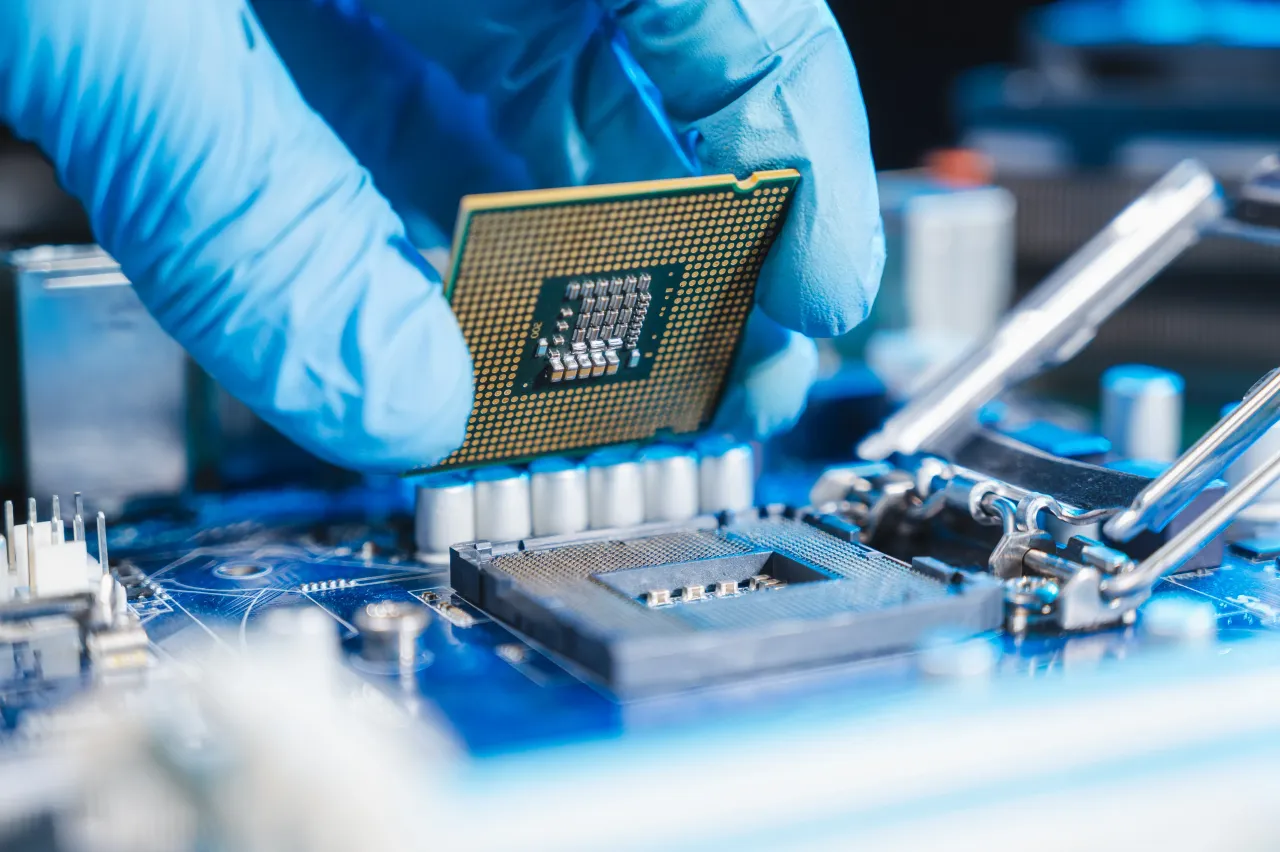


- The Roundhill Memory ETF has benefited from the AI memory boom, as its top holdings include the biggest memory plays.
- Soaring prices for high-bandwidth memory and storage have added to the momentum.
- Micron Technology, SK Hynix, and Samsung Electronics make up about 75% of the ETF’s holdings.
Advertisement|Remove ads.
The new kid on the block among the artificial intelligence trade rush is memory, and investors are piling in fast.
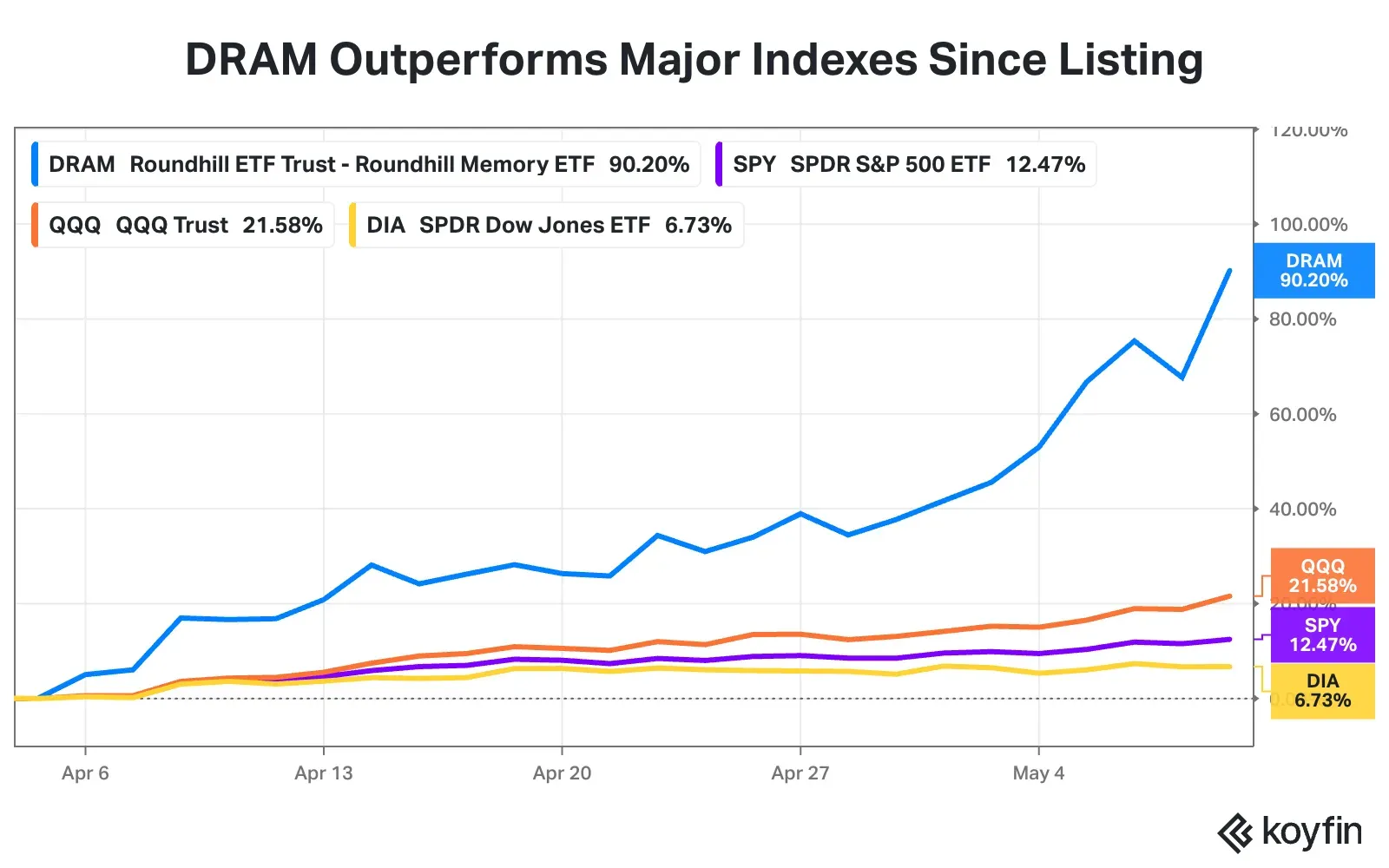
The newly-launched Roundhill Memory ETF (DRAM) has surged about 90% since its debut on April 2, quickly turning into one of the market’s hottest AI plays. The exchange-traded fund has surpassed major U.S. stock market indexes since its listing.

The Memory Supercycle
Memory chip stocks have rallied in 2026 amid an explosive demand for AI infrastructure that has far outpaced supply. Soaring prices for high-bandwidth memory and storage have added to the momentum.
Advertisement|Remove ads.
“Global semiconductor revenue is projected to increase 62.7% YoY in 2026, with the strongest growth in DRAM and NAND due to supply shortages, with DRAM revenue projected to nearly double YoY and NAND potentially quadrupling,” Beth Kindig, CEO and Lead Tech Analyst for the I/O Fund, noted in a post on X.
The Roundhill Memory ETF has benefited from this boom, as its top holdings comprise the biggest memory plays. Micron Technology Inc. (MU), South Korea’s SK Hynix, and Samsung Electronics make up about 75% of the ETF’s holdings.
| Name | Weight |
| Micron Technology Inc | 27.33% |
| SK hynix | 26.37% |
| Samsung Electronics Co | 20.42% |
| Sandisk | 5.94% |
| Kioxia Holdings | 5.68% |
| Seagate Technology Holdings | 4.70% |
| Western Digital | 4.22% |
As of May 10 | Source: Roundhill Investments
Advertisement|Remove ads.
MU shares have more than doubled since the ETF launched, while Samsung crossed the $1 trillion market capitalization milestone last week.
“In my view, we are still only at the threshold of a prolonged rally. While the memory market remains cyclical, the current upcycle is projected to last at least until 2028,” said Dmytro Lebid, investment consultant, trader, and financial analyst, in a post on X.
Lebid said he is bullish on Micron and SanDisk, adding, “Recent analysis confirms their high investment appeal and significant upside potential.”
Advertisement|Remove ads.
The Asian AI Exposure
Another reason for the fund’s popularity is its exposure to South Korea’s popular chip stocks SK Hynix and Samsung Electronics, according to Roundhill CEO Dave Mazza.
“These are two of the biggest memory companies and they’re essentially inaccessible for U.S. investors,” Mazza told CNBC. “If you buy a South Korea ETF, you’re gonna get other stuff you don’t want. And if you buy a semiconductor ETF, the weight of companies like Micron is too small.”
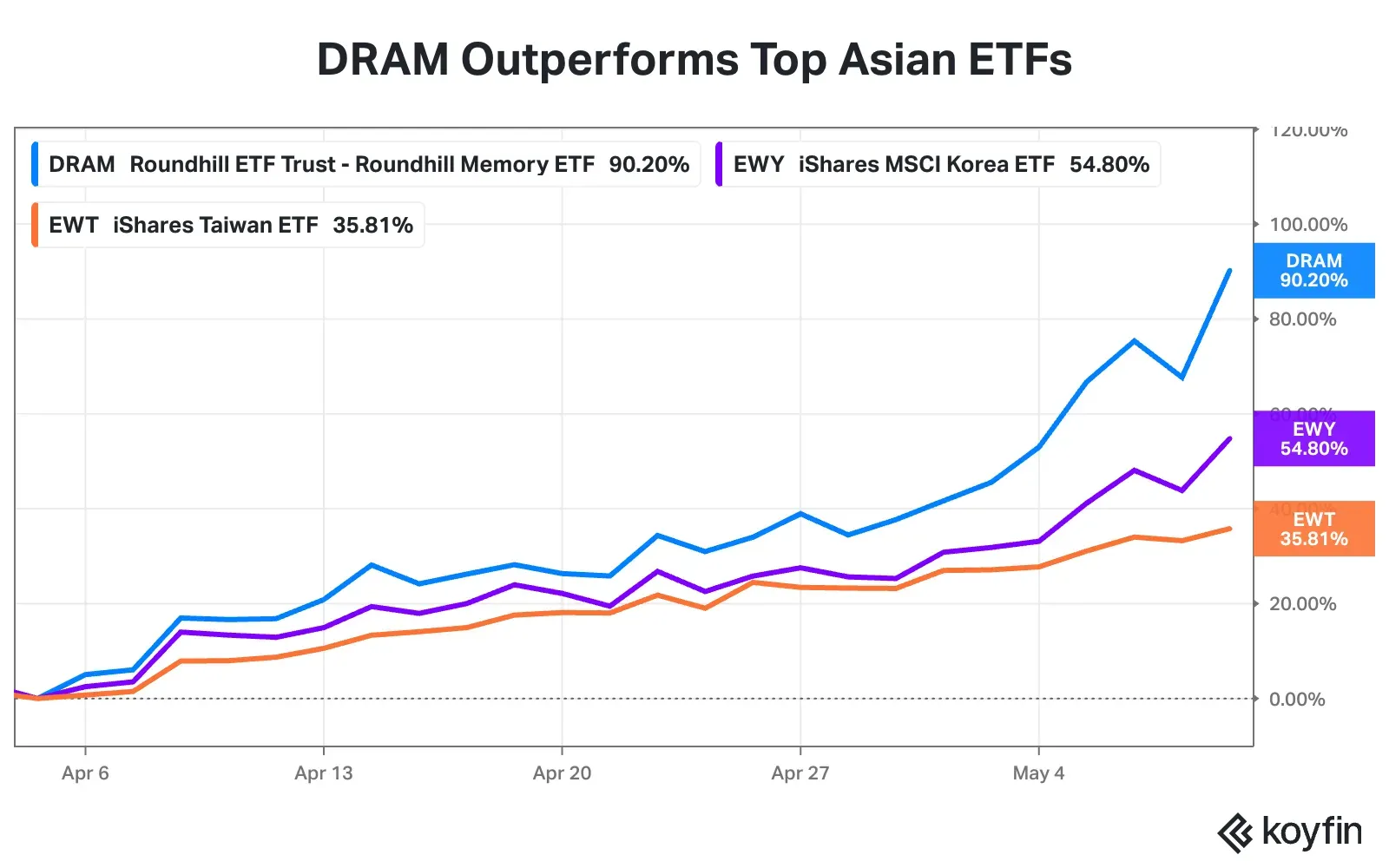
ETFs related to Taiwan and South Korea have outperformed Wall Street by a wide margin this year, as the Asian countries have posted historic stock market expansions driven by surging semiconductor demand.
Advertisement|Remove ads.
However, the DRAM ETF has surpassed the iShares MSCI South Korea ETF (EWY) and the iShares MSCI Taiwan ETF (EWT) since its debut.
Retail Stance On DRAM
On Stocktwits, retail sentiment around DRAM has been in the ‘extremely bullish’ territory amid ‘extremely high’ message volumes at the time of writing.
One bullish user said, “I'll sell both of my kidneys if i have to in order to get some call action here.”
Advertisement|Remove ads.
Another bullish user said, “The current price is at very attractive levels, sitting in areas that are expected to see a strong technical rebound amid rising tensions. The stock is currently considered an opportunity.” The user also added, “Opportunities like this do not happen every day.”
Advertisement|Remove ads.
DRAM was down about 0.06% in Monday’s premarket trading at the time of writing.
For updates and corrections, email newsroom[at]stocktwits[dot]com.
Comments posted here will also appear on symbol pages.

Latest News
/filters:format(webp)https://news.stocktwits-cdn.com/large_Getty_Images_2294264991_a1d08b075d.jpg)
/filters:format(webp)https://news.stocktwits-cdn.com/Anushka_Basu_make_me_smile_in_the_picture_b92832aa_af59_4141_aacc_4180d2241ba8_1_2_png_1086e0ed8c.webp) Anushka Basu·8h ago
Anushka Basu·8h ago/filters:format(webp)https://news.stocktwits-cdn.com/large_Getty_Images_1925090359_f160f05588.jpg) Anushka Basu·9h ago
Anushka Basu·9h ago/filters:format(webp)https://news.stocktwits-cdn.com/large_Getty_Images_2213700296_87303c323b.jpg) Anushka Basu·10h ago
Anushka Basu·10h ago/filters:format(webp)https://news.stocktwits-cdn.com/large_franklin_templeton_OG_jpg_4b3a7330d9.webp) Anushka Basu·11h ago
Anushka Basu·11h ago/filters:format(webp)https://news.stocktwits-cdn.com/large_Getty_Images_1445160636_5780a5fdde.jpg) Anushka Basu·13h ago
Anushka Basu·13h ago/filters:format(webp)https://news.stocktwits-cdn.com/Getty_Images_540198451_jpg_3e5f3d8ee7.webp) Anushka Basu·13h ago
Anushka Basu·13h ago