


Advertisement|Remove ads.
El-Erian Highlights Disappointments In Latest Consumer Confidence Data As Job, Income Concerns Loom Large


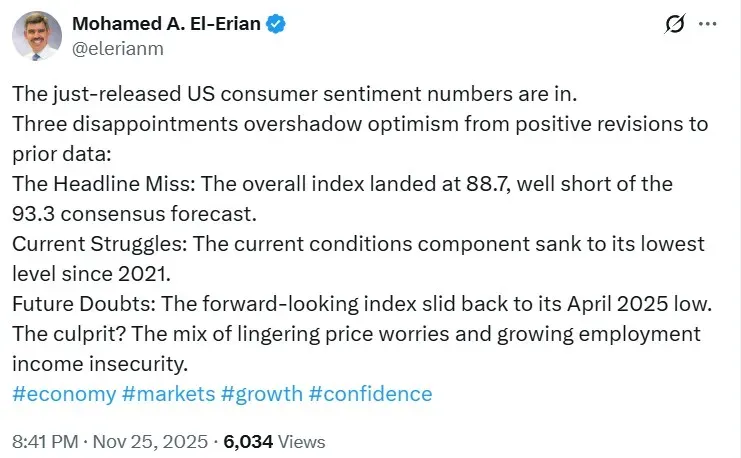
- The Conference Board survey for November showed consumer confidence at 88.7, below a Dow Jones estimate of 93.2.
- This was the lowest reading since April, according to the report.
- El-Erian also pointed to the decline in the index's current conditions component, noting it has fallen to its lowest level since 2021.
Advertisement|Remove ads.
Mohamed El-Erian, Chief Economic Advisor at Allianz, on Tuesday listed out three disappointing aspects of the latest Consumer Confidence report.
The economist noted in a post on X that the decline in consumers’ expectations of the future condition was due to a “mix of lingering price worries and growing employment income insecurity.”

Low On Confidence
The Conference Board survey for November showed consumer confidence at 88.7, below a Dow Jones estimate of 93.2, as cited by MarketWatch. This was the lowest reading since April, according to the report. El-Erian also noted that the current conditions component of the index has fallen to its lowest level since 2021.
Advertisement|Remove ads.
“All five components of the overall index flagged or remained weak. The Present Situation Index dipped as consumers were less sanguine about current business and labor market conditions,” said Dana M Peterson, Chief Economist, The Conference Board.
Inflation Focus
El-Erian stated earlier that focusing on inflation as an affordability metric ignores a critical component of the equation – income anxiety.
“It is income that is now under greater pressure, exposing the fragile financial foundation of too many households,” the economist said.
Advertisement|Remove ads.
El-Erian explained that income anxiety is also driven by the impact of artificial intelligence on the workforce and by the rise in layoffs.
According to data from Challenger, Gray & Christmas, U.S.-based employers trimmed more than 153,000 jobs in October due to artificial intelligence and cost-cutting.
Meanwhile, U.S. equities gained in Tuesday’s midday trade. At the time of writing, the SPDR S&P 500 ETF (SPY), which tracks the S&P 500 index, was up by 0.73%, the Invesco QQQ Trust ETF (QQQ) rose 0.32%, while the SPDR Dow Jones Industrial Average ETF Trust (DIA) gained 1.21%. Retail sentiment around the S&P 500 ETF on Stocktwits was in the ‘bearish’ territory.
Advertisement|Remove ads.
The iShares 7-10 Year Treasury Bond ETF (IEF) was up by 0.35% at the time of writing.
For updates and corrections, email newsroom[at]stocktwits[dot]com.
Advertisement|Remove ads.
Comments posted here will also appear on symbol pages.

Latest News
/filters:format(webp)https://st-everywhere-cms-prod.s3.us-east-1.amazonaws.com/large_eli_lilly_hq_resized_af4cc05fd5.jpg)
/filters:format(webp)https://news.stocktwits-cdn.com/Heera_1_1c30cb0170.PNG) Heera Hari·11m ago
Heera Hari·11m ago/filters:format(webp)https://news.stocktwits-cdn.com/large_Getty_Images_2274862442_jpg_5211d9550f.webp)
/filters:format(webp)https://news.stocktwits-cdn.com/Anushka_Basu_make_me_smile_in_the_picture_b92832aa_af59_4141_aacc_4180d2241ba8_1_2_png_1086e0ed8c.webp) Anushka Basu·1h ago
Anushka Basu·1h ago/filters:format(webp)https://news.stocktwits-cdn.com/gettyimages_2278069829_594x594_96874d5ac3.jpg)
/filters:format(webp)https://news.stocktwits-cdn.com/Harshita_3cfe02022c.jpg) Harshita Tyagi·1h ago
Harshita Tyagi·1h ago/filters:format(webp)https://news.stocktwits-cdn.com/large_RTX_Raytheon_2e21b4a62e.jpg) Heera Hari·2h ago
Heera Hari·2h ago/filters:format(webp)https://news.stocktwits-cdn.com/gettyimages_2213626542_612x612_3c8b123cbd.jpg)
/filters:format(webp)https://news.stocktwits-cdn.com/Prabhjote_DP_67623a9828.jpg) Prabhjote Gill·2h ago
Prabhjote Gill·2h ago/filters:format(webp)https://news.stocktwits-cdn.com/gettyimages_902959070_594x594_26e25e3cea.jpg) Harshita Tyagi·2h ago
Harshita Tyagi·2h ago