


Advertisement|Remove ads.
IMF’s Georgieva Sees Little More AI Market Correction Ahead – Here’s Her Take On What Could Lead To Potential Financial Stability Risks



- The IMF conservatively estimates AI could add half a percentage point to global economic growth.
- It estimates AI will affect 60% of jobs in advanced economies, though Georgieva said the technology could also create new employment opportunities.
- New U.S. chip curbs have had limited immediate impact on Southeast Asia, but she warned a deeper US-China tech split could have more significant consequences.
Advertisement|Remove ads.
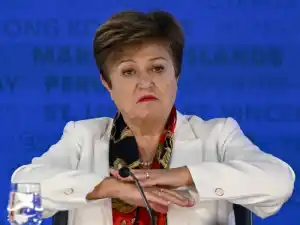
International Monetary Fund (IMF) Managing Director Kristalina Georgieva said Thursday that AI-related financial markets could face further correction, although she does not currently anticipate a major downturn.
Speaking to Bloomberg Television in Shenzhen, China, Georgieva said the IMF had expected some adjustment even before the recent market weakness because enthusiasm surrounding artificial intelligence had become excessive.

“At this point we don’t see a major correction, but we do expect perhaps a little bit more,” she said, adding that an adjustment could bring markets to a more sustainable level.
Advertisement|Remove ads.
Semiconductor stocks have seen some correction recently. The iShares Semiconductor ETF (SOXX) has fallen over 11% in the last month, while the VanEck Semiconductor ETF (SMH) has also tumbled over 12% during this period.
AI Financing Raises Stability Concerns
Georgieva highlighted the growing use of circular financing, in which companies provide funding to customers that subsequently purchase their products or services.
She estimated circular financing is about $1 trillion, with one-third financed through equity and two-thirds through debt. “It is not yet at the stage where we worry,” the IMF chief told Bloomberg.
Advertisement|Remove ads.
However, Georgieva warned about the pace of growth and the gradual shift from equity financing toward debt. “This creates a potential financial stability risk, if left unattended,” she said, emphasizing the importance of transparency and companies recognizing when financial exposures become more dangerous.
She also cautioned that technological revolutions often generate excessive short-term expectations, followed by disappointment when the anticipated benefits take longer to materialize.
AI Demand, Economic Growth Remain Strong
Despite the concerns, Georgieva pointed to growing demand for AI services across construction, education, healthcare and agriculture, alongside increased adoption in professional activities.
Advertisement|Remove ads.
She said AI was already affecting productivity and employment, with routine middle-skilled jobs facing displacement or consolidation.
The IMF estimates that 60% of jobs in advanced economies will be affected by AI, although Georgieva noted that the technology could also create new employment opportunities.
She said the IMF conservatively estimates that AI could add half a percentage point to global economic growth.
Advertisement|Remove ads.
Talking about the new U.S. restrictions on advanced chips, Georgieva said their immediate economic impact on Southeast Asian countries was limited. However, she warned that a deeper technological separation between the United States and China could have more significant consequences if other countries were forced to choose between competing systems.
For updates and corrections, email newsroom[at]stocktwits[dot]com
Advertisement|Remove ads.
Comments posted here will also appear on symbol pages.

Latest News
 Harshita Tyagi·12m ago

 Arnab Paul·1h ago

 Prabhjote Gill·2h ago

 Heera Hari·2h ago
 Harshita Tyagi·2h ago
 Arnab Paul·2h ago