


Advertisement|Remove ads.
MU, SNDK, SKHY Jump As Nvidia Tests Kioxia Memory Fix — Analyst Presses Memory Giants For ‘Massive’ Buybacks
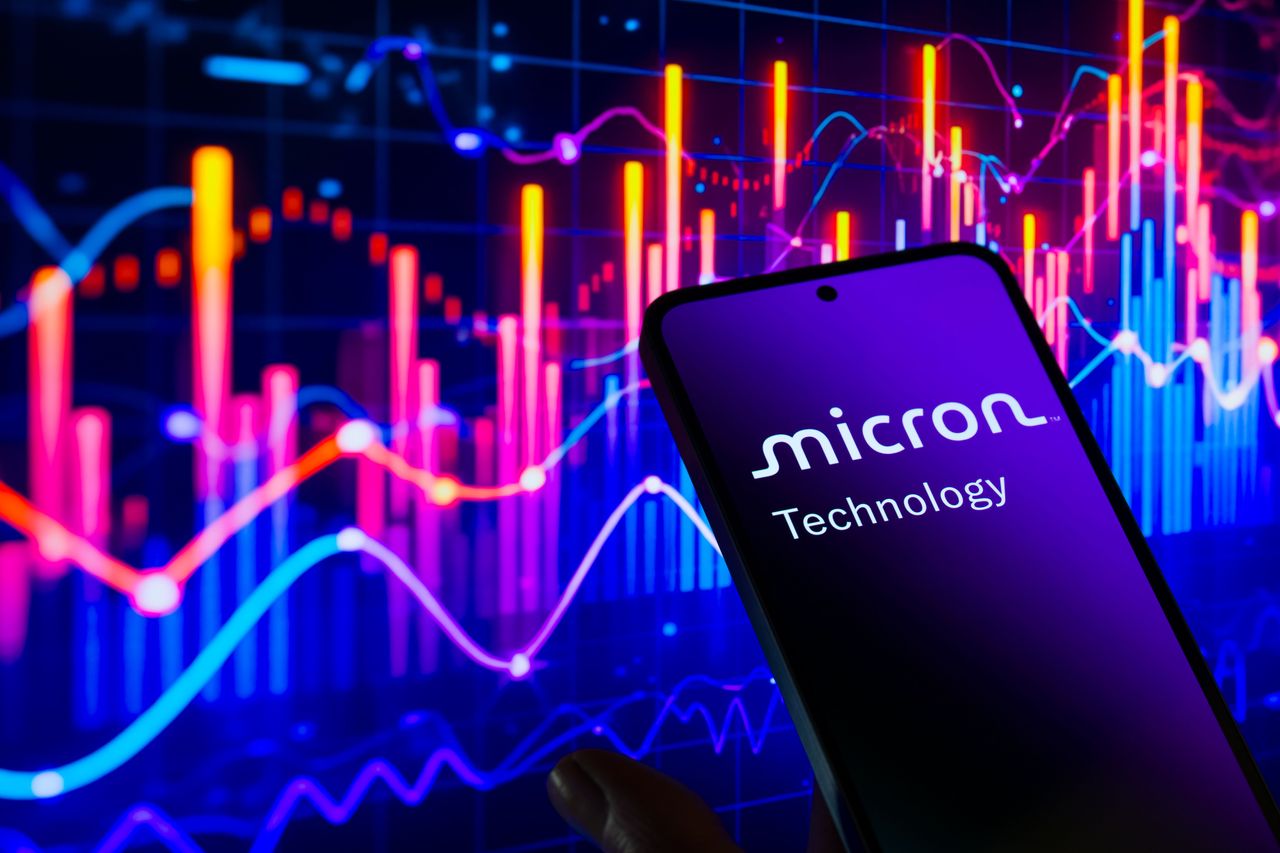


- The Nvidia Way author Tae Kim urged memory chipmakers to back their long-term forecasts with “massive stock buybacks.”
- Micron can begin using its $35.16 billion buyback authorization on Dec. 9 under its U.S. CHIPS Act funding agreements.
- SanDisk spent $5 billion on buybacks in its latest quarter. SK hynix plans to buy back and retire at least 60 trillion won worth of shares.
Advertisement|Remove ads.
Shares of Micron (MU), SanDisk (SNDK) and SK hynix (SKHY) jumped overnight heading into Thursday after Kioxia said its flash drives could help Nvidia’s AI chips access a database of up to 2 trillion vectors. For ‘The Nvidia Way’ author Tae Kim, the question is how much confidence memory chipmakers have in their own long-term forecasts. He urged them to show it with “massive stock buybacks.”
SNDK led the gains overnight, rising 4%, followed by SKHY up nearly 3%, MU up over 2%, and NVDA up over 1%.
In Tokyo, Kioxia Holdings shares climbed nearly 15% to 7,895 yen on Thursday. A day earlier, the company said its operating unit would pay it 2.21 trillion yen on Friday. The cash stays within the Kioxia group. Shareholders will receive a separate payout on Dec. 8, when Kioxia pays its first interim dividend.
Advertisement|Remove ads.
Nvidia Tests A Way Past GPU Memory Limits
Nvidia’s (NVDA) GB200 NVL72 rack pairs 72 GPUs with 13.4 terabytes of high-bandwidth memory (HBM). When an AI database exceeds capacity, the system may have to process it in batches and repeatedly move data between storage and memory. Nvidia’s SCADA software lets the GPUs retrieve small blocks of data directly from solid-state drives.
For the test, Kioxia equipped one rack with 144 XD8 drives, adding about 1.1 petabytes of raw flash storage, which is 80 times the capacity of the rack’s high-bandwidth memory. Kioxia estimates that the setup could support a database of up to 2 trillion 512-byte vectors, the numerical representations AI systems use to find related information. The companies are still evaluating how efficiently the rack can process data at that scale.
“The intelligence of AI agents will increasingly depend on the knowledge they can access, not just the compute power they consume,” said Jason Hardy, Nvidia’s vice president of storage tech.
Advertisement|Remove ads.
Kioxia also reported results for its next-gen GP2 drive. In a separate test, it handled more than 18 million random reads per second using 512-byte blocks, nearly twice its predecessor’s rate. Kioxia expects to send evaluation samples to select customers by the end of 2027.
Tae Kim’s Buyback Call
Kim urged memory chipmakers to back their forecasts by buying their own shares. For Micron, he pointed to Dec. 9. “Otherwise, all the talk about a strong multi-year outlook is just empty words. Show the market through actions,” he said on X.
Tae Kim is a technology journalist, author of ‘The Nvidia Way’ and founder of Key Context, a newsletter covering AI and the chip industry.
Advertisement|Remove ads.
Dec. 9 is when Micron can start using its $35.16 billion buyback authorization under its U.S. CHIPS Act funding agreements. Last month, the board added about $33 billion to the $2.16 billion left under an earlier authorization, based on the company’s quarterly cash flow. Micron can decide how much of that amount to spend. For comparison, it spent $650 million repurchasing 2.5 million shares in all of fiscal 2026.
On the other hand, SanDisk spent $5 billion buying back shares in the quarter ended Oct. 2 and still had $10.5 billion available for further purchases. SK hynix, meanwhile, plans to buy back and retire at least 60 trillion won worth of its shares as part of its fiscal 2026 shareholder returns.
SanDisk’s Sales Show Where Flash Demand Is Growing
Data centers are becoming a bigger business for SanDisk, which makes flash memory with Kioxia. In its latest quarter, SanDisk’s data-center revenue rose 61% from the previous quarter to $4.8 billion, while consumer revenue fell 29% to $397 million. The partners are planning for the shift. In August, they outlined plans to invest more than $31 billion in Japan through 2032, contingent on government support.
Advertisement|Remove ads.
SK hynix could soon become Kioxia’s largest shareholder. It said last week that a bond conversion and share purchase would give it an indirect stake of about 14%. Micron, meanwhile, is already selling drives for AI workloads. In September, it said customers were receiving two lines of SSDs for systems that reuse earlier calculations to speed up AI responses.
For investors, the question is how quickly those new uses translate into orders. TrendForce said on Wednesday that Chinese cloud providers had cut their planned enterprise SSD purchases for 2027 by more than North American buyers had added. The firm expects growing supply to push NAND flash contract prices lower next year, even as it forecasts a 29% rise in industry revenue.
How Do Retail Traders Feel About Tech Stocks?
On Stocktwits, retail sentiment was ‘bullish’ for MU, SNDK and NVDA amid ‘high’ message volume, while SKHY drew ‘neutral’ sentiment amid ‘normal’ message volume.
Advertisement|Remove ads.
So far this year, SNDK has gained 148%, and MU has climbed 111%, while NVDA has fallen 20%. SKHY is down 25% from its July IPO price.
For updates and corrections, email newsroom[at]stocktwits[dot]com.
Read Next: SpaceX Reportedly Slashes Some Nvidia Chip Rents — AI Researcher Sees Musk’s Edge In A GPU Glut
Advertisement|Remove ads.

Latest News
 Deepti Sri·14m ago

 Shivani Kumaresan·43m ago

 Aashika Suresh·1h ago

 Yuvraj Malik·1h ago
 Deepti Sri·1h ago
 Shivani Kumaresan·2h ago
Comments posted here will also appear on symbol pages.