


Advertisement|Remove ads.
Nvidia CEO Reportedly Spoke To Trump On The Importance Of Keeping Chinese Developers On The American Tech Stack, Says Howard Lutnick
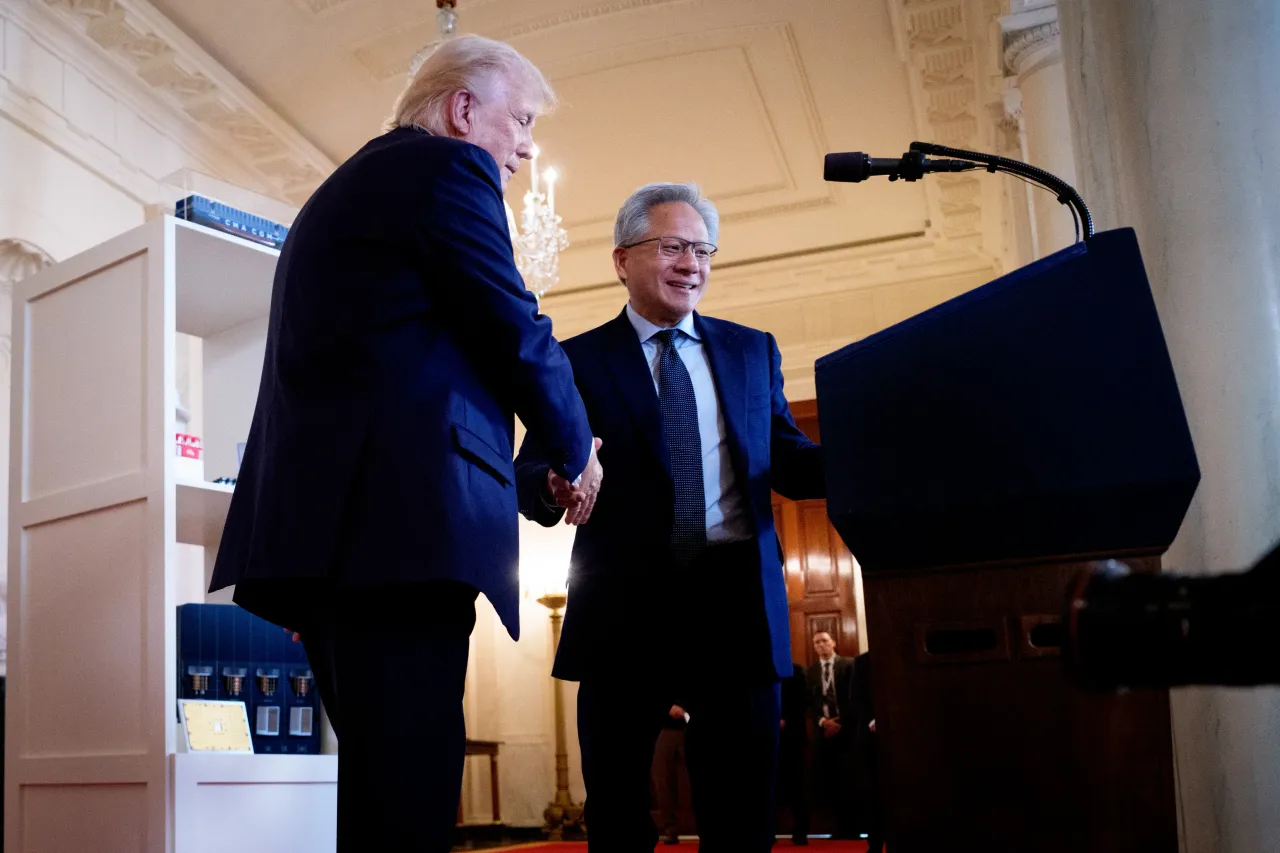


- Jensen Huang’s pitch to President Donald Trump centered on keeping Chinese developers tied to U.S. technology.
- He reportedly said that long-term U.S. leadership in AI depends on ensuring that global developers continue to build on American platforms.
- The export approval of Nvidia’s H200 chips has reportedly prompted Chinese government officials to hold emergency meetings with local tech giants like Alibaba.
Advertisement|Remove ads.
Nvidia CEO Jensen Huang reportedly spoke to President Donald Trump on the strategic importance of ensuring Chinese developers use American technology rather than China’s own tech stack to convince him to approve the export of Nvidia’s H200 chips to China.
U.S. Commerce Secretary Howard Lutnick told CNBC on Thursday that the two discussed the deal at least a dozen times before it was finalized. He explained that Huang’s central argument was around long-term U.S. advantage in artificial intelligence.
“They talked about it a lot. More than a dozen times.”
Howard Lutnick, U.S. Secretary of Commerce
Nvidia’s stock fell as much as 1.4% in pre-market trading. On Stocktwits, retail sentiment around the AI bellwether trended in ‘bearish’ territory over the past day.
Advertisement|Remove ads.
Keeping Talent on American Platforms
The CEO reportedly told Trump that if Chinese developers become accustomed to domestic technology, they would gain expertise that could eventually challenge U.S. leadership. By contrast, requiring them to work on American systems would maintain leverage, ensuring that Chinese developers remain partially dependent on U.S. innovations.
China, on the other hand, has reportedly been holding emergency meetings with local tech giants like Tencent (TCEHY), ByteDance (BYTEDANCE), and Alibaba (BABA) to ascertain their demand for Nvidia’s H200 chips after the approval came in on Monday. Government officials will decide on how many chips, if any, to import once those numbers come in.
A Financial Times report said Beijing still plans to restrict access to H200 chips even after the U.S. greenlight, signaling an effort to reduce domestic reliance on American GPUs.
Advertisement|Remove ads.
Export Approval Comes With Fees, Limits
Trump announced Monday that H200 exports would be permitted, subject to a 25% sales fee. The H200 is described as the “second-best” Nvidia chip permitted for shipment to China under U.S. rules. Blackwell-class B300 parts remain barred.
The export approval followed months of debate between the two governments amid escalating competition over AI supply chains and the strategic role of Nvidia hardware in global development.
Read also: PayPal Faces Growing Wall Street Pessimism Over Q4 Growth Slump – BofA Latest To Downgrade Stock
Advertisement|Remove ads.
For updates and corrections, email newsroom[at]stocktwits[dot]com.
Comments posted here will also appear on symbol pages.

Latest News
/filters:format(webp)https://st-everywhere-cms-prod.s3.us-east-1.amazonaws.com/large_charles_schwab_resized_79fd4282b7.jpg)
/filters:format(webp)https://news.stocktwits-cdn.com/Anushka_Basu_make_me_smile_in_the_picture_b92832aa_af59_4141_aacc_4180d2241ba8_1_2_png_1086e0ed8c.webp) Anushka Basu·1h ago
Anushka Basu·1h ago/filters:format(webp)https://news.stocktwits-cdn.com/large_Getty_Images_1236413131_82e1a6f16e.jpg) Anushka Basu·2h ago
Anushka Basu·2h ago/filters:format(webp)https://news.stocktwits-cdn.com/large_Getty_Images_2255514431_jpg_95e96b4025.webp)
/filters:format(webp)https://st-everywhere-cms-prod.s3.us-east-1.amazonaws.com/i_OS_App_Icon_1_8054f2a2fe.png) Stocktwits News Desk·2h ago
Stocktwits News Desk·2h ago/filters:format(webp)https://news.stocktwits-cdn.com/large_US_economy_representative_image_jpg_88c3aa4736.webp) Stocktwits News Desk·3h ago
Stocktwits News Desk·3h ago/filters:format(webp)https://news.stocktwits-cdn.com/large_Getty_Images_2245498821_jpg_a630ddc6e3.webp) Stocktwits News Desk·4h ago
Stocktwits News Desk·4h ago/filters:format(webp)https://news.stocktwits-cdn.com/large_Getty_Images_2187692895_jpg_1d5aec6424.webp) Anushka Basu·4h ago
Anushka Basu·4h ago