


Advertisement|Remove ads.
Oil Plummets, US Stocks Climb After Trump Agrees To Hold Off On Iran Strikes For Two Weeks



- The president also said that the U.S. had received a 10-point proposal from Iran, which was workable for negotiations.
- Sharif had previously said that efforts to reach a peaceful settlement on the war in the Middle East were in progress, with potentially substantive results in near future.
- Trump had issued a warning to Iran earlier on Tuesday about striking Iran if it did not reopen the Strait of Hormuz.
Advertisement|Remove ads.
Oil prices declined sharply in Tuesday’s post-market hours, while U.S. stocks edged higher after U.S. President Donald Trump agreed to postpone attacks on Iran by two weeks.
The announcement comes shortly after Prime Minister Sharif urged Trump to extend the deadline for strikes on Iran by two weeks, while also asking Iran to reopen the Strait of Hormuz.
Brent crude futures expiring in June 2026 fell by more than 5.7% to $103.42 per barrel, while WTI crude futures expiring in May 2026 dipped about 7.7% to $104.24 per barrel after-hours following the announcement.
Advertisement|Remove ads.
The United States Oil Fund ETF (USO) lost about 7.4% in extended trading hours, while the ProShares Ultra Bloomberg Crude Oil ETF (UCO) was down about 5.3% at the time of writing.
Meanwhile, stock markets edged higher. The SPDR S&P 500 ETF (SPY), which tracks the S&P 500 index, climbed up 1.5% in after-hours trading, the Invesco QQQ Trust ETF (QQQ) edged 1.7% higher; and the SPDR Dow Jones Industrial Average ETF Trust (DIA) was up 1.56%.
Temporary Ceasefire
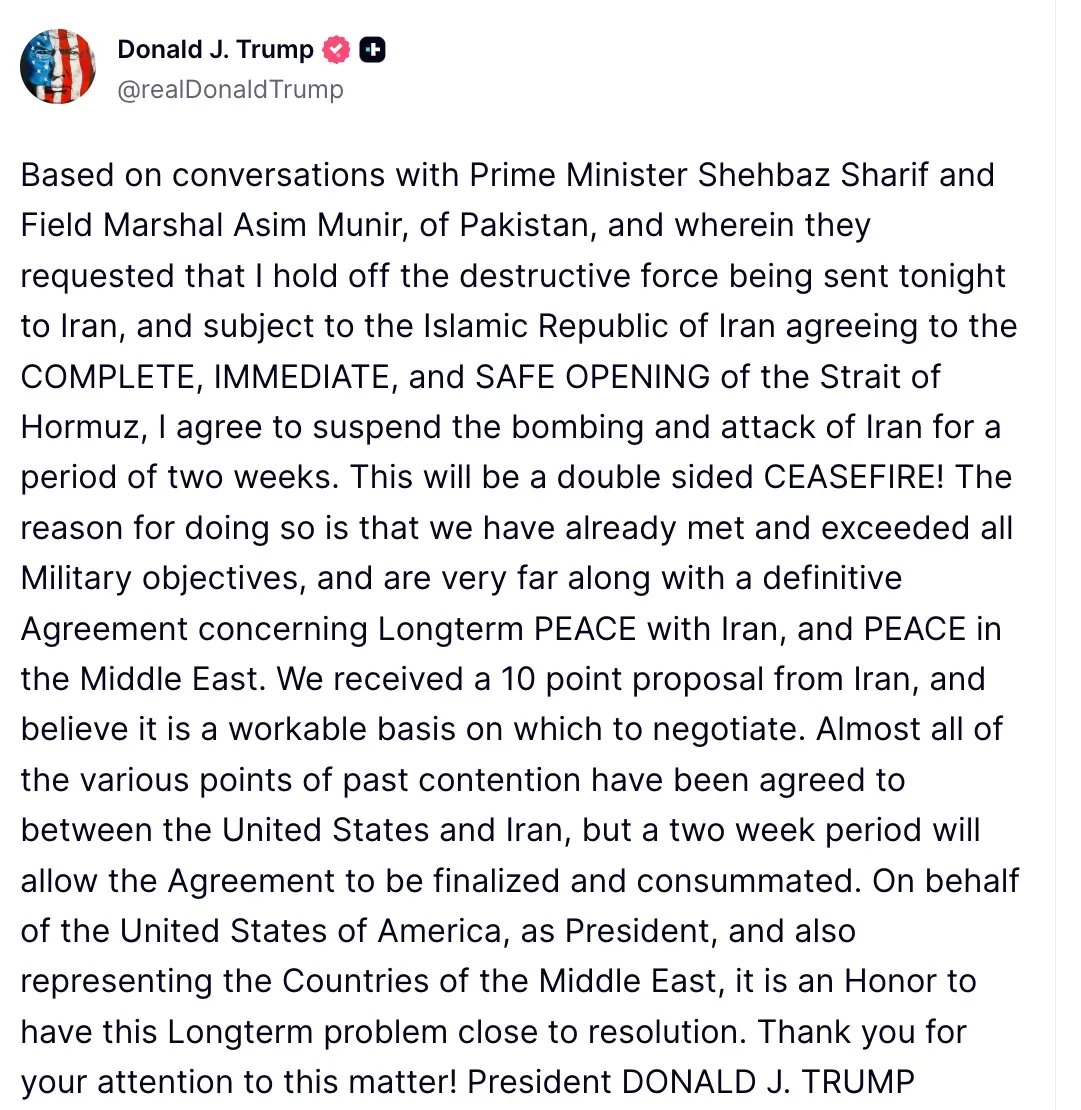
In a post on Truth Social on Tuesday, Trump said that based on conversations with Pakistan Prime Minister Shehbaz Sharif and the country’s Field Marshal Asim Munir, the U.S. would back down from strikes on Iran for two weeks, subject to “COMPLETE, IMMEDIATE, and SAFE OPENING of the Strait of Hormuz.”
Advertisement|Remove ads.
“This will be a double sided CEASEFIRE!” Trump said.
The president also said that the U.S. had received a 10-point proposal from Iran, which was “workable” to negotiate. “Almost all of the various points of past contention have been agreed to between the United States and Iran, but a two week period will allow the Agreement to be finalized and consummated. On behalf of the United States of America, as President, and also representing the Countries of the Middle East, it is an Honor to have this Longterm problem close to resolution,” Trump said.
Pakistan’s Intervention
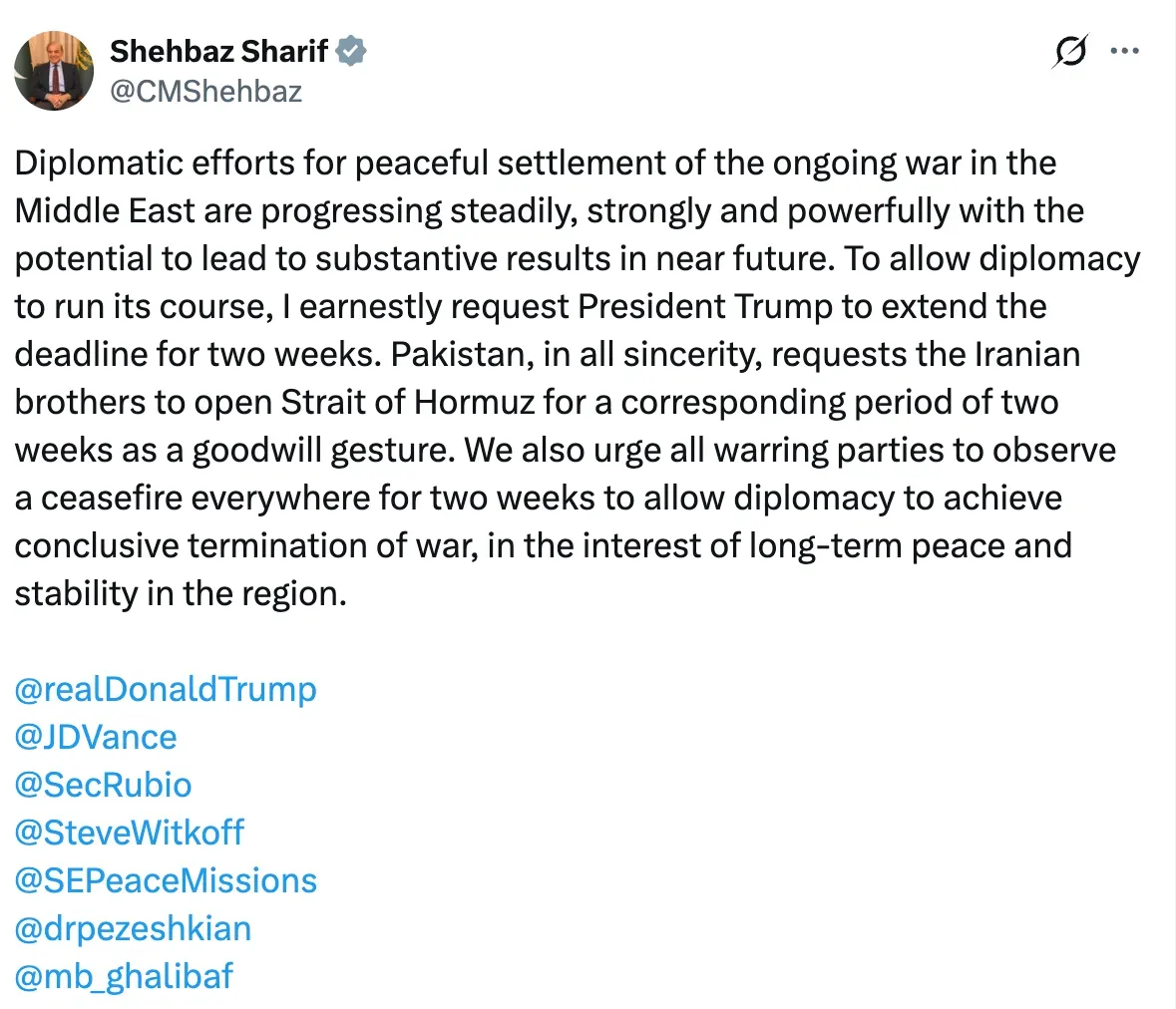
Meanwhile, Pakistan’s Sharif had said in a post on X, that efforts to reach a peaceful settlement on the war in the Middle East were in progress, with potentially substantive results in near future.
Advertisement|Remove ads.
“To allow diplomacy to run its course, I earnestly request President Trump to extend the deadline for two weeks,” he said, adding that, “Pakistan, in all sincerity, requests the Iranian brothers to open Strait of Hormuz for a corresponding period of two weeks as a goodwill gesture.”
Pakistan and Egypt have been playing mediator between the U.S. and Iran amid the war that is now in its 39th day.
Advertisement|Remove ads.
Trump had earlier issued a warning to Iran on Tuesday via a Truth Social post, saying that he would strike the country, leading to a situation where the “whole civilization will die tonight,” while also adding that though he did not want it to happen, it probably would.
Editor’s Note: This story has been updated to reflect Trump’s comments from Truth Social.
For updates and corrections, email newsroom[at]stocktwits[dot]com.
Advertisement|Remove ads.
Comments posted here will also appear on symbol pages.

Latest News
/filters:format(webp)https://news.stocktwits-cdn.com/gettyimages_1161631184_594x594_0063399eed.jpg)
/filters:format(webp)https://news.stocktwits-cdn.com/1707726834303_jpg_11f20a9aa9.webp) Shashank Nayar·55m ago
Shashank Nayar·55m ago/filters:format(webp)https://news.stocktwits-cdn.com/large_Getty_Images_2200924488_4b2d171fd3.jpg)
/filters:format(webp)https://news.stocktwits-cdn.com/unnamed_jpg_9dff551b50.webp) Anan Ashraf·1h ago
Anan Ashraf·1h ago/filters:format(webp)https://news.stocktwits-cdn.com/large_Getty_Images_2297777279_225c04fb05.jpg) Shashank Nayar·1h ago
Shashank Nayar·1h ago/filters:format(webp)https://news.stocktwits-cdn.com/large_Getty_Images_2295831097_b515d94e2b.jpg) Shashank Nayar·2h ago
Shashank Nayar·2h ago/filters:format(webp)https://news.stocktwits-cdn.com/large_rocket_lab_peter_beck_jpg_4d8fc790a1.webp) Anan Ashraf·3h ago
Anan Ashraf·3h ago/filters:format(webp)https://news.stocktwits-cdn.com/large_Federal_Reserve_a31f9e5606.jpg) Shashank Nayar·3h ago
Shashank Nayar·3h ago