


Advertisement|Remove ads.
Bitcoin, Oil, Gold Rally: Peter Schiff Questions Fed's Credibility, Says 'Investors Are Choosing Their Preferred Hedge'


- Gold reached $4,600 an ounce, and silver approached $70.
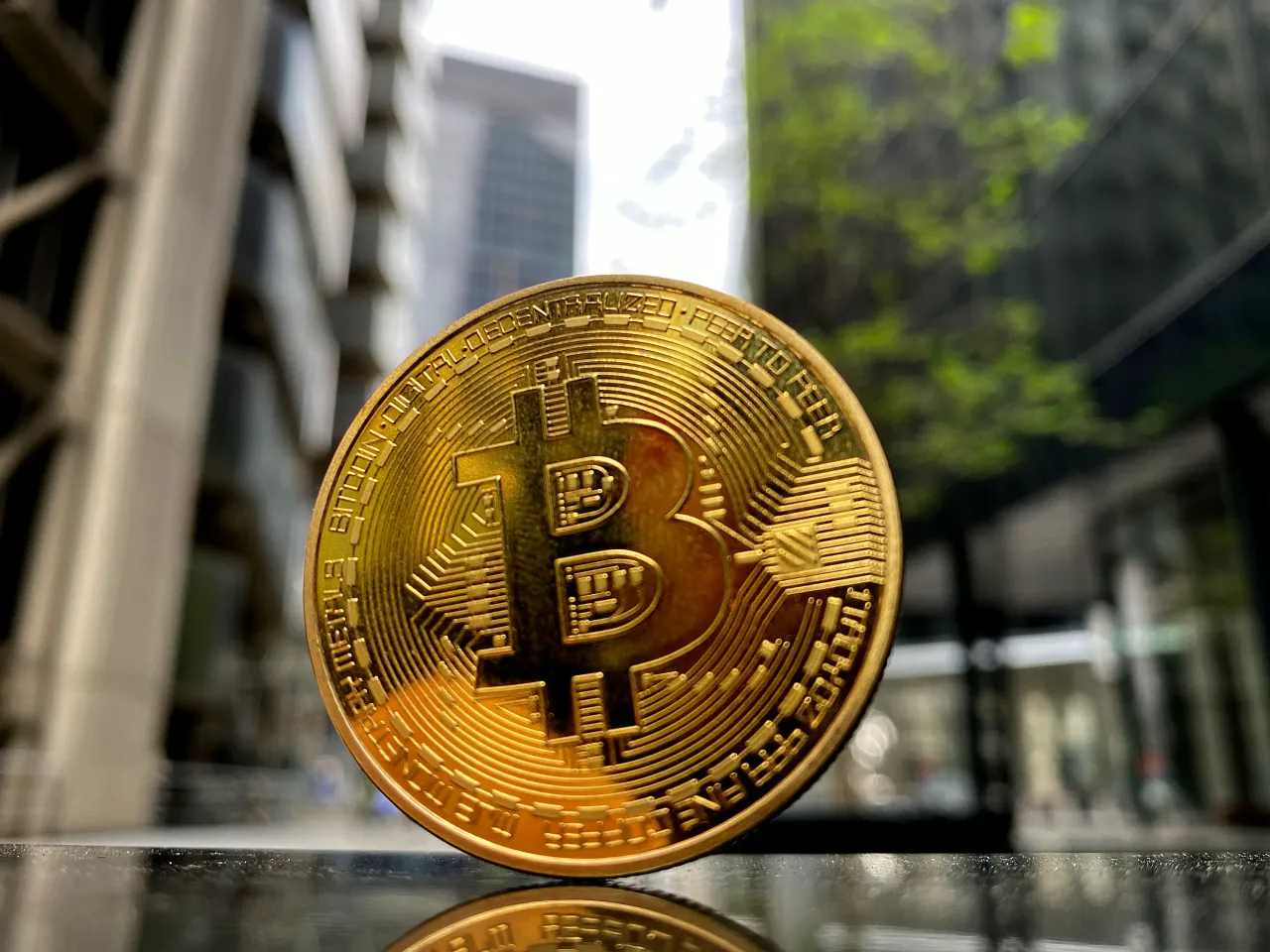
- Bitcoin briefly climbed above $79,000 before giving back some of its gains.
- Schiff’s comments followed a volatile week in which the Treasury said it would at least double the size of some longer-dated bond buybacks.
Advertisement|Remove ads.
Gold bull and longtime Bitcoin critic Peter Schiff said Friday that the simultaneous rally in gold, silver, oil and Bitcoin (BTC) reflects a broader loss of confidence in the Federal Reserve's commitment to returning inflation to its 2% target.
“Gold hitting $4,600, silver near $70, oil over $87, and Bitcoin's earlier spike above $79K show the Fed has lost all credibility on its commitment to returning inflation to 2%,” Schiff wrote in a post on X. “Treasury made it clear the Fed will choose inflation, so investors are choosing their preferred hedge.”

Bitcoin’s price gained 7.3% in the last 24 hours, trading at around $77,200 after paring gains from an intra-day high of over $79,000.
Advertisement|Remove ads.
The apex cryptocurrency was the top-trending ticker on Stocktwits at the time of writing, alongside BTC Treasury Strategy (MSTR).
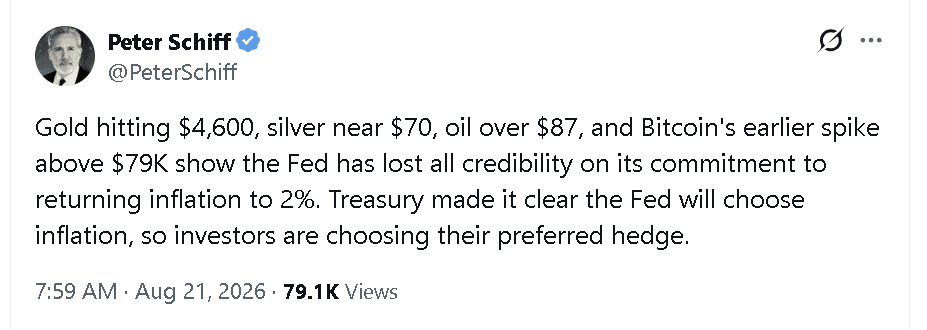
Schiff’s comments came after a volatile week across global markets, during which the U.S. Treasury announced plans to at least double the size of certain buyback operations for longer-dated government bonds, raising the maximum size from $2 billion to $4 billion.
Gold, Silver, Bitcoin Rally Together
Alongside the rally in Bitcoin, spot gold touched $4,600 per ounce on Friday, and spot silver climbed above $70. The SPDR Gold Shares ETF (GLD) rose 1.3% in morning trade, with retail sentiment in ‘neutral’ territory over the past day. The iShares Silver Trust (SLV) gained 2%, with retail sentiment in ‘bullish’ territory.
Advertisement|Remove ads.
Brent crude rose to an intraday high above $94 a barrel before easing to around $93.70, while West Texas Intermediate crude touched more than $87 before paring gains to about $86.30. The United States Oil Fund (USO) edged 0.23% lower in morning trade, with retail sentiment falling to ‘bearish’ from ‘neutral’ territory over the past day.
According to Schiff, the simultaneous rally suggests investors are seeking alternatives to assets directly tied to the U.S. dollar and the Treasury market.
The Fed Still Has An Inflation Problem
The Treasury said the larger buyback operations were intended to provide additional liquidity support to longer-dated parts of the bond market. The move provided an immediate reprieve, but the unfolding tensions between the U.S. and Iran continue to weigh on markets.
Advertisement|Remove ads.
Treasury yields climbed higher on Friday after U.S. Treasury Secretary Scott Bessent said on Thursday that Washington plans to impose "the toughest sanctions in history" on Iran. The U.S. 30-year Treasury yield was trading at 5.27% at the time of writing, while the U.S. 10-year Treasury yield climbed to 4.72%.
According to Schiff, concerns around persistent inflation, large fiscal deficits and a U.S. national debt that has surpassed $40 trillion remain. Bond-market pressure has also been compounded by rising borrowing needs across the private sector, including heavy financing demands tied to AI infrastructure.
At its July meeting, the Federal Reserve kept its policy rate unchanged at 3.5% to 3.75% and acknowledged that inflation remained elevated relative to its 2% goal. The central bank also said supply shocks, including higher energy prices, were contributing to price pressures.
Advertisement|Remove ads.
For updates and corrections, email newsroom[at]stocktwits[dot]com.
Comments posted here will also appear on symbol pages.

Latest News
/filters:format(webp)https://news.stocktwits-cdn.com/large_Bloom_Energy_jpg_de9372f92d.webp)
/filters:format(webp)https://news.stocktwits-cdn.com/Aashika_Suresh_Profile_Picture_jpg_2acd6f446c.webp) Aashika Suresh·13m ago
Aashika Suresh·13m ago/filters:format(webp)https://news.stocktwits-cdn.com/large_Getty_Images_2199291636_jpg_3c282601d9.webp)
/filters:format(webp)https://news.stocktwits-cdn.com/unnamed_jpg_9dff551b50.webp) Anan Ashraf·1h ago
Anan Ashraf·1h ago/filters:format(webp)https://news.stocktwits-cdn.com/large_Getty_Images_2242240272_jpg_d3bdf11f05.webp)
/filters:format(webp)https://news.stocktwits-cdn.com/1707726834303_jpg_11f20a9aa9.webp) Shashank Nayar·1h ago
Shashank Nayar·1h ago/filters:format(webp)https://news.stocktwits-cdn.com/gettyimages_1161631184_594x594_0063399eed.jpg) Shashank Nayar·2h ago
Shashank Nayar·2h ago/filters:format(webp)https://news.stocktwits-cdn.com/large_Getty_Images_2292004491_8f62e72b72.jpg) Anan Ashraf·3h ago
Anan Ashraf·3h ago/filters:format(webp)https://news.stocktwits-cdn.com/large_Getty_Images_2270719078_54f1c6207b.jpg) Anan Ashraf·3h ago
Anan Ashraf·3h ago