


Advertisement|Remove ads.
TSLA Stock Eyes Weekly Loss: Retail Investors Grill Musk On Missed Robotaxi Targets Ahead Of Q2 Earnings
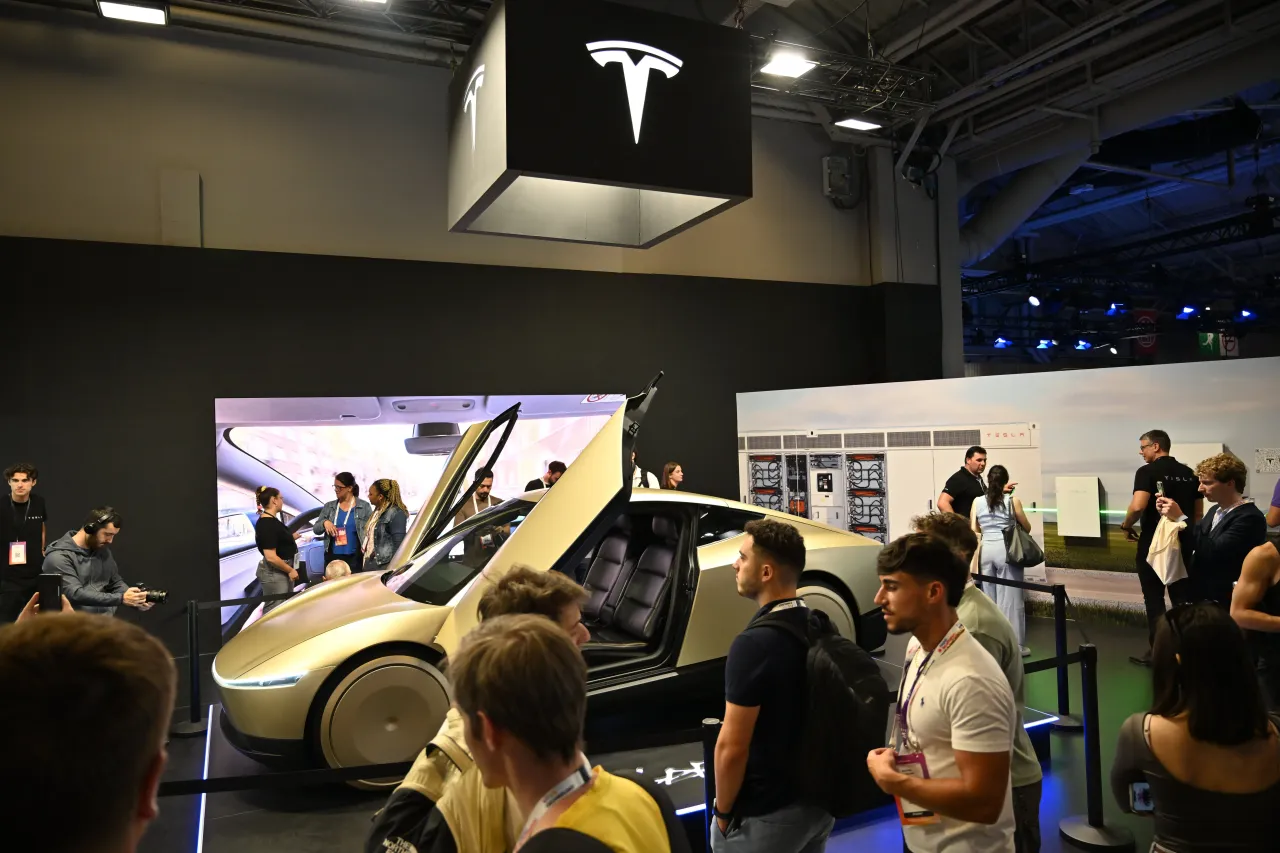


- Robotaxi delays and repeatedly missed autonomy targets dominate shareholder questions.
- Tesla’s 2020 Robotaxi goal never materialized, while Cybercab production is ramping slowly.
- Koyfin expects Q2 revenue to rise 17% and adjusted EPS to increase 31%.
Advertisement|Remove ads.
Tesla, Inc. (TSLA) heads into next week's second-quarter (Q2) earnings with growing pressure from its retail investor base, as Robotaxi delays, missed milestones, and the Optimus production ramp dominate shareholder questions.
TSLA stock is down 3% so far this week, with shares also down 0.3% in premarket trading on Thursday.
Robotaxi Delays Dominate TSLA Questions
Robotaxi is by far the dominant theme among the highest-ranked retail questions. The EV giant is expected to report its Q2 results on July 22. One of the most-upvoted submissions asks why Tesla has repeatedly missed its own autonomy targets: "Tesla has missed short term guidance on robotaxi 3 earnings reports in a row... What is keeping Tesla back from accomplishing these short term goals that they've set for themselves?"
Advertisement|Remove ads.
Another asks: "Why has growth of robotaxi vehicles stalled? When will we see Cybercab start customer rides?"
Investors are also demanding concrete operating metrics, including fleet size, paid rides, intervention rates, cost per mile and revenue contribution, instead of broader progress updates. Others want revised rollout milestones after earlier targets were missed.
Musk said in 2019 that Tesla could have one million Robotaxis on the road by the end of 2020, a target that never materialized as Full Self-Driving (FSD) remained a supervised system. Tesla reset expectations during its October 2024 Cybercab unveiling, targeting unsupervised Robotaxi operations in Texas and California in 2025 and volume production of Cybercabs in 2026. The company launched a limited paid Robotaxi service in Austin in June 2025 before beginning production of Cybercab earlier this year, though Musk cautioned that the initial production ramp would be "agonizingly slow."
Advertisement|Remove ads.
Optimus Ramp Draws Retail Scrutiny
Optimus was the second most-discussed topic, with shareholders seeking updates on Gen 3 production, factory deployment and commercial rollout. The highest-ranked Optimus question asks about the Gen 3 production ramp, initial factory deployment and external sales timeline for 2027. Others ask how many Optimus robots are currently working inside Tesla factories, what tasks they perform and what manufacturing bottlenecks still stand in the way of mass production.
The questions mirror Robotaxi concerns. Tesla first targeted limited Optimus production in 2023 before shifting toward low-rate production and internal factory deployment through 2026. Musk has said that the ramp for Optimus is also "agonizingly slow," arguing that nearly every component is new.
TSLA Q2 Estimates Point To Growth
Koyfin estimates call for Q2 revenue of $26.29 billion, up 17% from a year ago. Adjusted earnings per share (EPS) is expected to rise 31% to $0.54. Morgan Stanley raised its price target to $417 from $415 and maintained an 'Equal Weight' rating, implying a 6% upside from current levels. The firm expects a solid quarter but continues to view Robotaxi and Optimus as the primary long-term value drivers.
Advertisement|Remove ads.
Barclays lifted its target to $370 and reiterated an 'Equal Weight' rating, implying a 6% downside, while Wells Fargo raised its target to $130 and maintained an 'Underweight' rating, implying a 67% downside. Jefferies raised its target to $400 from $375 while maintaining a 'Hold' rating, implying a 1% upside. The firm cited Tesla's delivery beat but warned that implied Cybercab production still points to further delays in the Robotaxi ramp.
How Do Retail Traders Feel About TSLA?
On Stocktwits, retail sentiment for TSLA slipped to ‘neutral’ from ‘bullish’ levels a day ago amid a 66% jump in 24-hour message volume.

One user said, “$TSLA clearly has been some strength since it’s been holding this level. With one option remaining for Friday leading into earnings week, I do expect a nice bounce tomorrow.”
Advertisement|Remove ads.
Another user said, “$TSLA it feels like this wants to flush before next weeks earnings then skyrocket afterwards.”
Advertisement|Remove ads.
So far this year, Tesla's stock has lagged its "Magnificent Seven" peers, making it the group's second-worst performer, down 12%.
For updates and corrections, email newsroom[at]stocktwits[dot]com.
Read Next: GRRR Stock Tracks Worst Rout In Over A Year — Here’s What Investors Are Watching Now
Advertisement|Remove ads.
Comments posted here will also appear on symbol pages.

Latest News
/filters:format(webp)https://news.stocktwits-cdn.com/large_Getty_Images_1231213491_c9dc5aa96b.jpg)
/filters:format(webp)https://news.stocktwits-cdn.com/1707726834303_jpg_11f20a9aa9.webp) Shashank Nayar·10m ago
Shashank Nayar·10m ago/filters:format(webp)https://news.stocktwits-cdn.com/large_Getty_Images_2279844042_ca48b68602.jpg)
/filters:format(webp)https://news.stocktwits-cdn.com/Anushka_Basu_make_me_smile_in_the_picture_b92832aa_af59_4141_aacc_4180d2241ba8_1_2_png_1086e0ed8c.webp) Anushka Basu·37m ago
Anushka Basu·37m ago/filters:format(webp)https://news.stocktwits-cdn.com/large_Nu_Holdings_resized_jpg_46611caf95.webp)
/filters:format(webp)https://news.stocktwits-cdn.com/Prabhjote_DP_67623a9828.jpg) Prabhjote Gill·46m ago
Prabhjote Gill·46m ago/filters:format(webp)https://st-everywhere-cms-prod.s3.us-east-1.amazonaws.com/large_hal_gatewood_i_Pl3q_g_E_Gz_Y_unsplash_f5aaa11469.jpg)
/filters:format(webp)https://news.stocktwits-cdn.com/vivekkrishnanphotography_58_jpg_0e45f66a62.webp) Arnab Paul·1h ago
Arnab Paul·1h ago/filters:format(webp)https://news.stocktwits-cdn.com/large_Getty_Images_2183604828_0179169ddb.jpg) Anushka Basu·2h ago
Anushka Basu·2h ago/filters:format(webp)https://news.stocktwits-cdn.com/large_microsoft_office_jpg_db5ba55187.webp)
/filters:format(webp)https://news.stocktwits-cdn.com/Heera_1_1c30cb0170.PNG) Heera Hari·2h ago
Heera Hari·2h ago