


Advertisement|Remove ads.
Will US Markets Keep Ripping Higher Despite Iran Volatility? Retail Traders Lean Bullish, Wall Street Not So Much


- Mohamed El-Erian, Chief Economic Advisor at Allianz, said the latest developments in the Strait of Hormuz would have adverse implications for global growth.
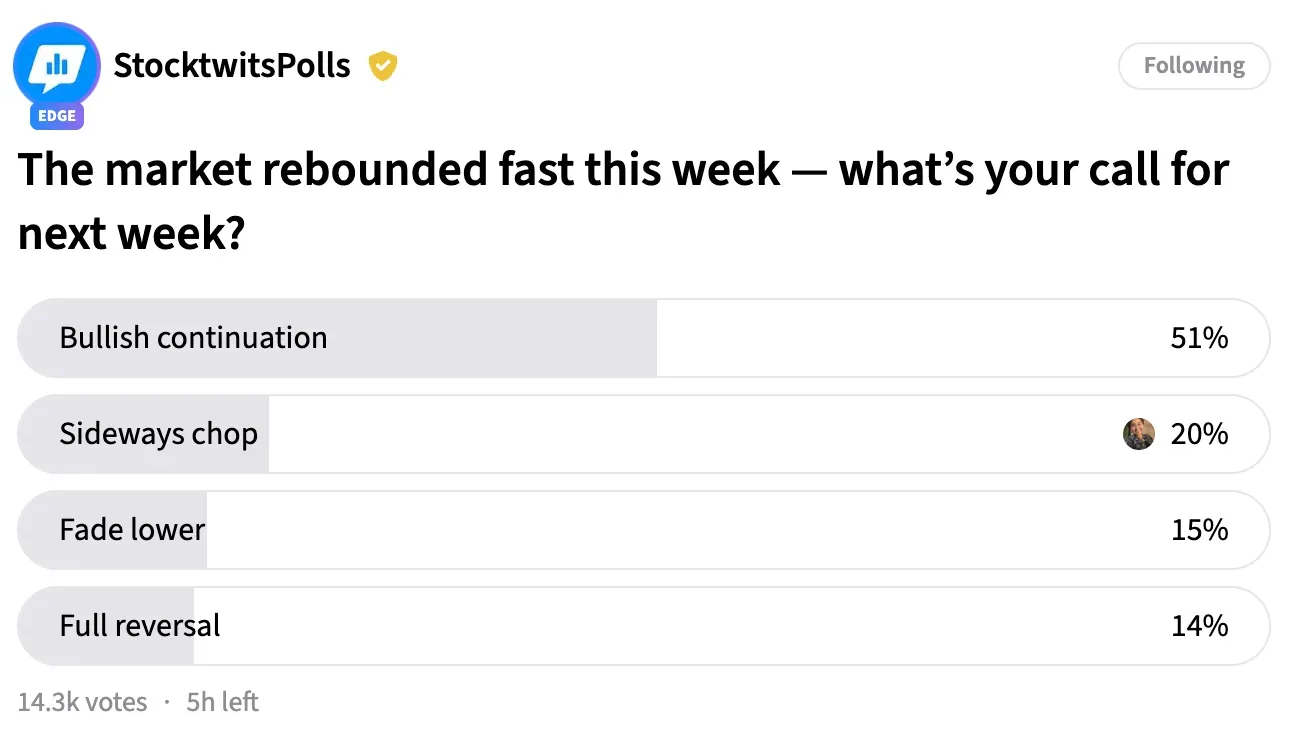
- An ongoing Stocktwits poll gauging retail sentiment about the upcoming week’s market performance found that just over half of voters said the market would exhibit a bullish continuation.
- However, U.S. President Donald Trump on Sunday said that an Iranian-flagged cargo ship had been seized in the Strait of Hormuz, sending markets into the red zone again.
Last week, U.S. stock markets climbed to record highs as investors grew optimistic about de-escalations in the Middle East, with the benchmark S&P 500 crossing the 7,100 mark for the first time.
An ongoing Stocktwits poll gauging retail sentiment about the upcoming week’s market performance found that a majority of voters were bullish on U.S. markets for the following week. The poll received about 14,300 responses at the time of writing.
Just more than half the voters (51%) said the market would exhibit “bullish continuation,” while 20% voted for a sideways chop. Meanwhile, 15% of users who voted believe that U.S. markets will fade lower in the coming week, while the remaining 14% expected a full reversal from last week’s gains.
However, U.S. President Donald Trump on Sunday said that an Iranian-flagged cargo ship had been seized in the Strait of Hormuz, sending markets lower and oil prices higher in overnight trading.
Retail Weighs In
One bullish user said that while U.S. indexes were extended at the moment, they were not exhausted. The user also added, “Rotation is broadening, not narrowing.” The user predicted that sector rotation signals for next week would likely be significant, with momentum shifting toward defense or aerospace stocks, AI infrastructure, biotechnology, and microcaps, while momentum in mega-cap tech would cool off.
Another user said that the upward momentum would continue if the deal with Iran held, but markets would probably tumble if the deal fell through.
A third user noted that the tensions in the Strait of Hormuz had “gotten worse,” although markets could potentially shrug it off; it was too soon to tell.
What’s Wall Street Betting On?
Meanwhile, Wall Street is not convinced about a sustained market rally. Mohamed El-Erian, Chief Economic Advisor at Allianz, said in a post on X that the latest developments in the Strait of Hormuz were putting pressure on oil prices and partially reversing Friday’s sharp drop, “notwithstanding the adverse implications for global growth.”
Kenneth Goh, director of private wealth management at UOB Kay Hian Pte., reportedly told Bloomberg News that while the S&P 500 had surged to a record high on Friday, the surge was based on the assumption that the Iran deal would hold. However, “the weekend showed that it is not a safe assumption,” Goh told Bloomberg, adding that “What matters now is whether ships can actually move through the Strait of Hormuz.”
Overnight US Market Reaction
U.S. markets reversed in Sunday’s overnight trading, slipping lower after Iran’s decision to keep the Strait of Hormuz closed following Trump’s declaration of the U.S. Navy blocking Iranian ports, and later announcing the seizure of an Iranian-flagged cargo ship.
At the time of writing, the SPDR S&P 500 ETF (SPY), which tracks the S&P 500 index, and the Invesco QQQ Trust ETF (QQQ) both fell by 0.52% in overnight hours, and the SPDR Dow Jones Industrial Average ETF Trust (DIA) fell 0.58%.
Retail sentiment on Stocktwits regarding the S&P 500 ETF was in the ‘extremely bullish’ territory.
For updates and corrections, email newsroom[at]stocktwits[dot]com.

Latest News
/filters:format(webp)https://news.stocktwits-cdn.com/large_new_york_stock_exchange_jpg_e1f85c0d8c.webp)
/filters:format(webp)https://st-everywhere-cms-prod.s3.us-east-1.amazonaws.com/Rounak_Author_Image_7607005b05.png) Rounak Jain·11m ago
Rounak Jain·11m ago/filters:format(webp)https://news.stocktwits-cdn.com/large_capitol_market_OG_jpg_8111684a8f.webp)
/filters:format(webp)https://st-everywhere-cms-prod.s3.us-east-1.amazonaws.com/Prabhjote_DP_67623a9828.jpg) Prabhjote Gill·17m ago
Prabhjote Gill·17m ago/filters:format(webp)https://news.stocktwits-cdn.com/large_Getty_Images_2263602596_jpg_6eb5e30d9e.webp)
/filters:format(webp)https://news.stocktwits-cdn.com/IMG_6979_jpg_a2a1032fdc.webp) Ahmed Farhath·43m ago
Ahmed Farhath·43m ago/filters:format(webp)https://news.stocktwits-cdn.com/large_nyse_OG_2_jpg_0e4e1c68f2.webp) Prabhjote Gill·47m ago
Prabhjote Gill·47m ago/filters:format(webp)https://news.stocktwits-cdn.com/large_Getty_Images_2243840626_jpg_6a78fa8844.webp)
/filters:format(webp)https://news.stocktwits-cdn.com/vivekkrishnanphotography_58_jpg_0e45f66a62.webp) Arnab Paul·55m ago
Arnab Paul·55m ago/filters:format(webp)https://news.stocktwits-cdn.com/large_Getty_Images_2198547045_jpg_e6c30993de.webp)
/filters:format(webp)https://news.stocktwits-cdn.com/Chinmay_Rautmare_Photo_jpeg_96dd37efd0.webp) Chinmay Rautmare·1h ago
Chinmay Rautmare·1h ago