











Advertisement|Remove ads.
China Déjà Vu? Trump’s No-Strike On Iran Announcement Stokes Deal Speculation Even As Markets Brace For Volatility
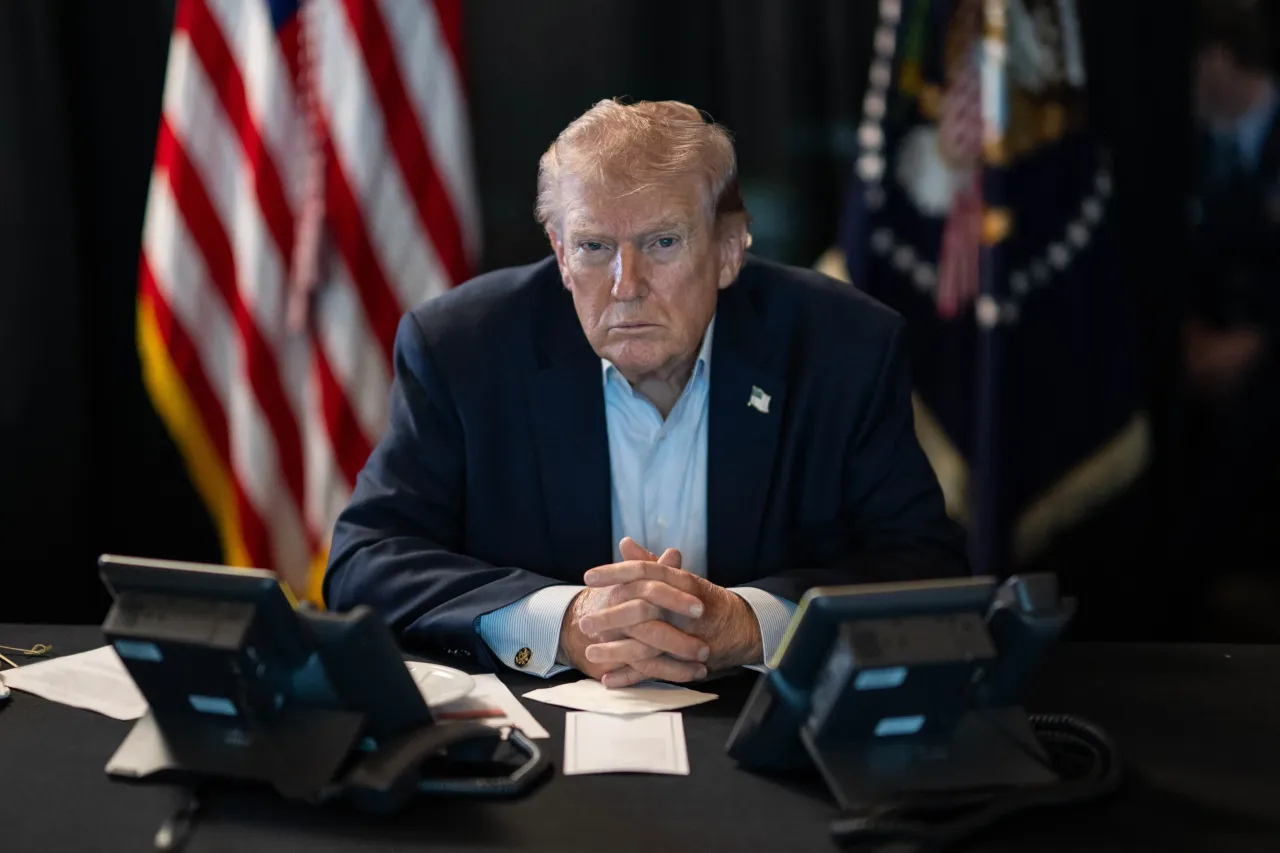


- As per The Kobeissi Letter, a similar sequence of events unfolded in 2025 when the U.S. and China were engaged in trade talks.
- Despite the potential negotiations, The Kobeissi Letter expects market volatility to persist in the short term “until there is a clear agreement in place.”
- Trump said on Monday that he had instructed the Department of War to postpone military action against Iran’s power plants and energy infrastructure for five days.
U.S. President Donald Trump’s decision to hold off on strikes against Iran and indicating “productive” conversations is stirring a sense of déjà vu for some market participants who are drawing parallels to past China trade tensions.
The Kobeissi Letter, which provides market commentary, said in a post on X on Monday that it “firmly” believes that the U.S. and Iran are engaged in ongoing negotiations, based on events that transpired during the May 2025 trade deal with China.
Despite the potential negotiations, The Kobeissi Letter expects market volatility to persist in the short term “until there is a clear agreement in place.”
Trump said on Monday in a post on Truth Social that he had instructed the Department of War to “postpone any and all military strikes against Iranian power plants and energy infrastructure” for five days. Stock markets turned green after the announcement.
The China-Iran Parallels
As per The Kobeissi Letter, a similar sequence of events unfolded in 2025 when the U.S. and China were engaged in trade talks. Trump had signaled a deal was in the works amid soaring yields, even as Beijing denied negotiations, much like Iran’s current response. A senior Iranian official has reportedly denied any talks between the two countries.
However, weeks later, the U.S. and China announced their first trade deal, reducing tariffs to a 30% baseline, The Kobeissi Letter noted.
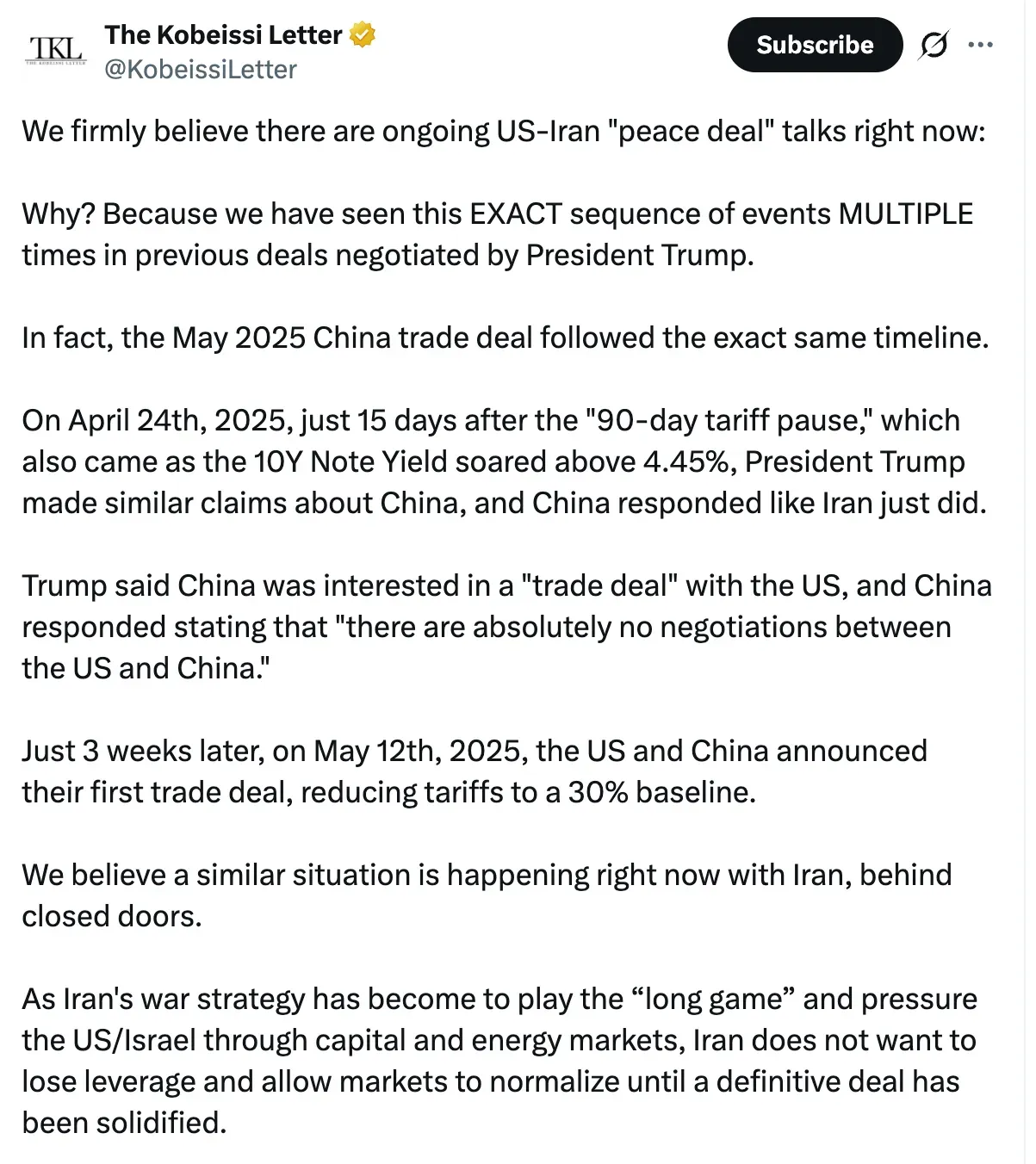
“We believe a similar situation is happening right now with Iran, behind closed doors,” said the X post. “As Iran's war strategy has become to play the ‘long game’ and pressure the US/Israel through capital and energy markets, Iran does not want to lose leverage and allow markets to normalize until a definitive deal has been solidified,” The Kobeissi Letter said, adding that Trump was following the same playbook.
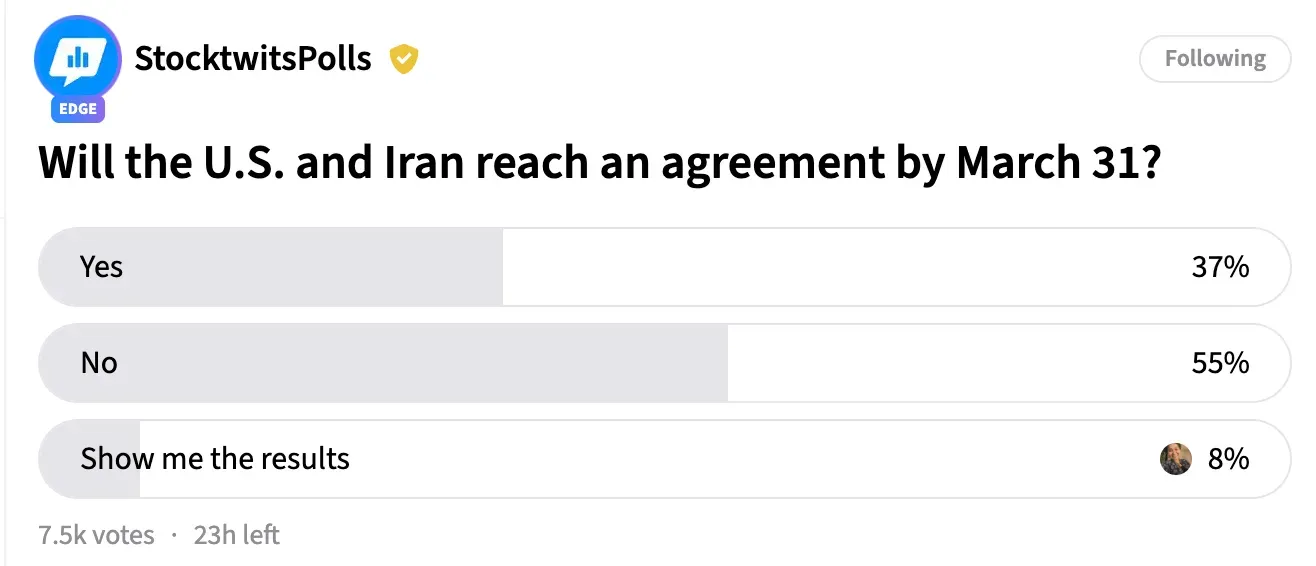
According to a Stocktwits poll asking users whether the U.S. and Iran would reach an agreement by March 31, 55% of respondents answered no.
Market Impact
However, the market commentator warned that short-term volatility would continue and a return to normal would take time.
“That said, volatility will persist until there is a clear agreement in place, and broader market normalization after this historic shock will take months,” the post said.
Meanwhile, at the time of writing, the SPDR S&P 500 ETF (SPY), which tracks the S&P 500 index, was up 1.46%; the Invesco QQQ Trust ETF (QQQ) also rose 1.46%; and the SPDR Dow Jones Industrial Average ETF Trust (DIA) climbed 1.77% higher.
Retail sentiment on Stocktwits regarding the S&P 500 ETF was in the ‘extremely bearish’ territory.
Oil prices plummeted amid the news, with the United States Oil Fund ETF (USO) declining 8.7% at the time of writing, while the ProShares Ultra Bloomberg Crude Oil ETF (UCO) was down nearly 13% at the time of writing.
For updates and corrections, email newsroom[at]stocktwits[dot]com.

Latest News
/filters:format(webp)https://news.stocktwits-cdn.com/large_Getty_Images_2218982575_jpg_744b1ac4e3.webp)
/filters:format(webp)https://st-everywhere-cms-prod.s3.us-east-1.amazonaws.com/unnamed_jpg_9dff551b50.webp) Anan Ashraf·43m ago
Anan Ashraf·43m ago/filters:format(webp)https://news.stocktwits-cdn.com/large_Getty_Images_2263898051_jpg_9e75888009.webp)
/filters:format(webp)https://news.stocktwits-cdn.com/Aashika_Suresh_Profile_Picture_jpg_2acd6f446c.webp) Aashika Suresh·2h ago
Aashika Suresh·2h ago/filters:format(webp)https://news.stocktwits-cdn.com/large_hyperliquid_OG_2_jpg_075f500726.webp)
/filters:format(webp)https://news.stocktwits-cdn.com/Anushka_Basu_make_me_smile_in_the_picture_b92832aa_af59_4141_aacc_4180d2241ba8_1_2_png_1086e0ed8c.webp) Anushka Basu·2h ago
Anushka Basu·2h ago/filters:format(webp)https://news.stocktwits-cdn.com/large_Trending_stock_resized_may_jpg_bc23339ae7.webp)
/filters:format(webp)https://news.stocktwits-cdn.com/vivekkrishnanphotography_58_jpg_0e45f66a62.webp) Arnab Paul·2h ago
Arnab Paul·2h ago/filters:format(webp)https://news.stocktwits-cdn.com/large_bnb_OG_jpg_7d8d37f348.webp)
/filters:format(webp)https://st-everywhere-cms-prod.s3.us-east-1.amazonaws.com/Prabhjote_DP_67623a9828.jpg) Prabhjote Gill·2h ago
Prabhjote Gill·2h ago/filters:format(webp)https://news.stocktwits-cdn.com/large_Getty_Images_2167490837_jpg_471b0d5535.webp) Anan Ashraf·2h ago
Anan Ashraf·2h ago