


Advertisement|Remove ads.
US Dollar Dominance Strengthens As Iran War Drives Safe-Haven Demand — SWIFT Data Confirms The Shift


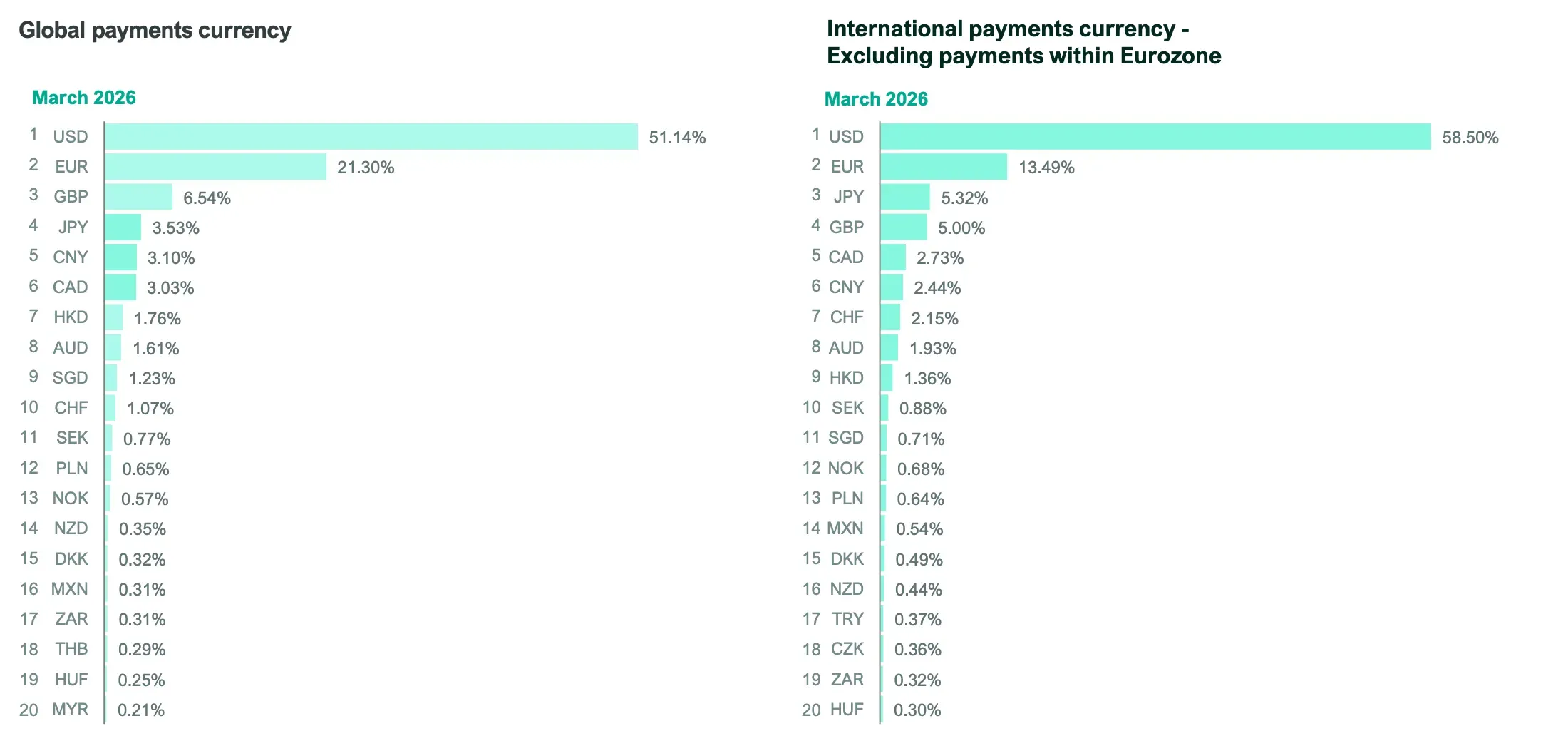
- The euro’s share in international transactions slipped to 21.30% in March from 22.82% February.
- David Lubin, Senior Research Fellow at Chatham House, noted in an article last week that investors flock to the dollar during crises because of its liquidity and the Federal Reserve’s lender-of-last-resort strength.
- The U.S. Dollar Index held steady around 98.63 on early Thursday, hovering near one-week highs.
Advertisement|Remove ads.
The U.S. dollar is still dominant in global trade, gaining prominence among global currencies amid escalating tensions in the Middle East.
According to data from the Society for Worldwide Interbank Financial Telecommunication (SWIFT), the greenback’s portion of global payments rose to 51.14% in March, up from 49.25% a month earlier. Excluding transactions with the Eurozone, its share increased to 58.5% from 57.49% in the same period.
In comparison, the euro’s share in international transactions slipped to 21.30% in March from 22.82% a month ago, and the pound’s share fell to 6.54% versus 7.16% in February.
Advertisement|Remove ads.
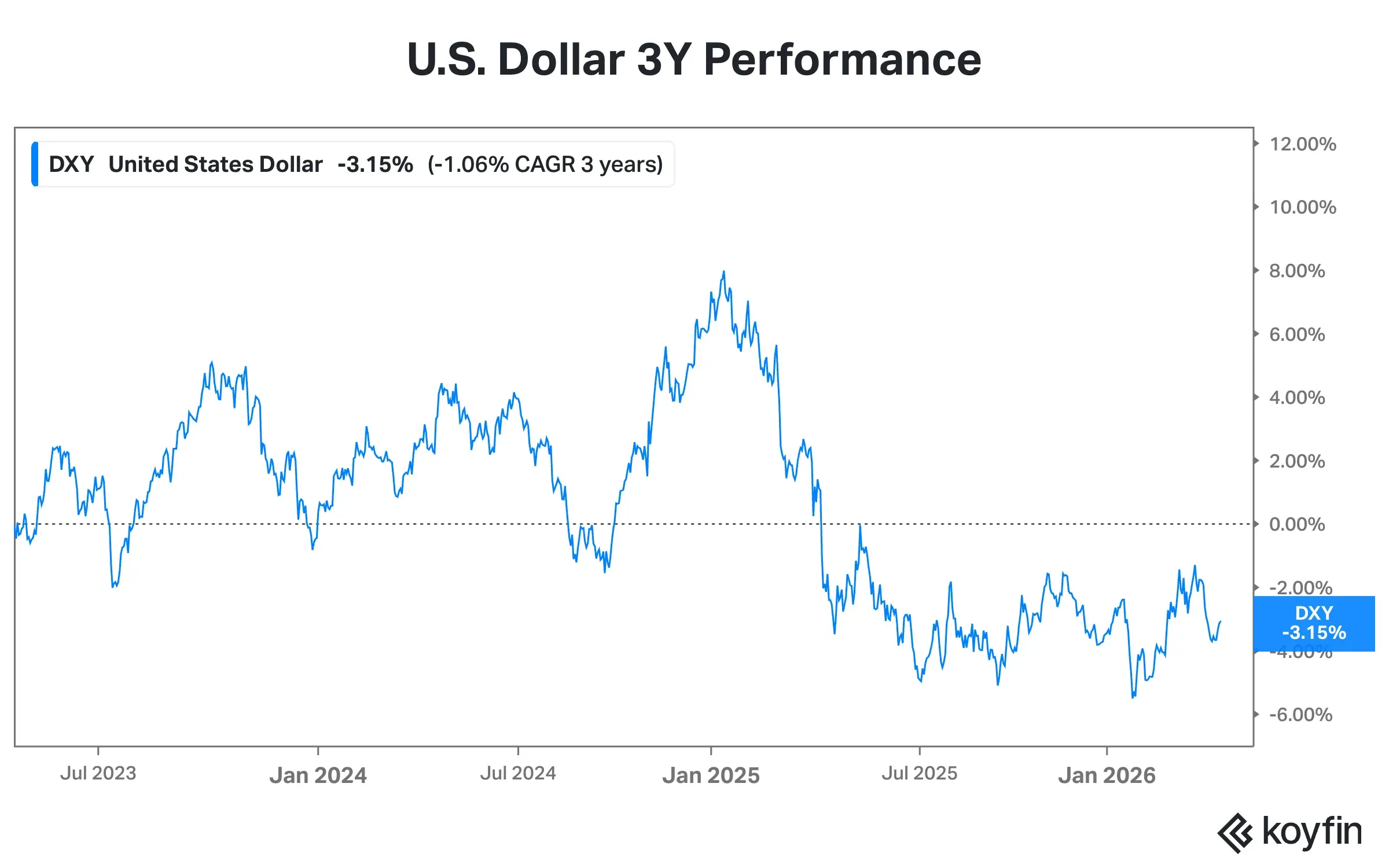
Meanwhile, the U.S. Dollar Index (DXY), a benchmark index that measures the value of the U.S. dollar against a basket of six major foreign currencies, held steady around 98.63 early Thursday, amid multi-year lows.
What This Means
In light of ongoing geopolitical uncertainty, with the war in Iran weighing on investor sentiment, the dollar's increased use reinforces its safe-haven role.
“As anxiety levels rise during a crisis, institutional investors and governments flock to dollar-denominated assets because US capital markets are easier to trade in and out of than any others; and because the ability of the Federal Reserve to act as lender and liquidity-provider of last resort is second to none,” said David Lubin, Senior Research Fellow at Chatham House, in an article with the British think tank on April 17.
Advertisement|Remove ads.
Lubin also noted that one of the key features of the dollar’s role as the top global reserve currency is that the US bond markets and the greenback act as safe havens in times of stress.
Market Reaction To War
The U.S. and Israel’s coordinated strikes against Iran are inching toward the two-month mark, even as the critical Strait of Hormuz remains closed, weighing heavily on global energy prices and heightened inflation risks. Oil prices have climbed back to over $100 a barrel, and inflation concerns persist.
Yet, Lubin noted that despite the S&P 500 index’s fall since the start of the war, it has declined less than its peers. He also noted that while the yield on U.S. government 10-year bonds has risen, it is still lower than many other American peers. “In the end, it is U.S. trustworthiness that underpins all this,” he said.
Advertisement|Remove ads.
Meanwhile, U.S. equities declined in Wednesday’s overnight session. At the time of writing, the SPDR S&P 500 ETF (SPY), which tracks the S&P 500 index, was down by 0.37%, the Invesco QQQ Trust ETF (QQQ) declined 0.30%, and the SPDR Dow Jones Industrial Average ETF Trust (DIA) fell 0.54%.
The WisdomTree Bloomberg U.S. Dollar Bullish Fund (USDU), an exchange-traded fund that seeks to gain from the dollar against a basket of currencies, has increased modestly by 0.66% in the past year. U.S. President Donald Trump’s global tariffs weighed heavily on the currency, although he had previously dismissed concerns over its weakening.
Meanwhile, the Invesco DB US Dollar Index Bullish Fund (UUP) has gained 1.36% in the same period. Retail sentiment for both remained in the ‘neutral’ territory at the time of writing.
Advertisement|Remove ads.
For updates and corrections, email newsroom[at]stocktwits[dot]com.
Comments posted here will also appear on symbol pages.

Latest News
/filters:format(webp)https://news.stocktwits-cdn.com/large_Getty_Images_1241478218_fce09285f2.jpg)
/filters:format(webp)https://news.stocktwits-cdn.com/Anushka_Basu_make_me_smile_in_the_picture_b92832aa_af59_4141_aacc_4180d2241ba8_1_2_png_1086e0ed8c.webp) Anushka Basu·2h ago
Anushka Basu·2h ago/filters:format(webp)https://news.stocktwits-cdn.com/large_Getty_Images_2290627662_00dc8e527a.jpg) Anushka Basu·2h ago
Anushka Basu·2h ago/filters:format(webp)https://news.stocktwits-cdn.com/large_Getty_Images_1925090364_jpg_cd701c3c60.webp) Anushka Basu·4h ago
Anushka Basu·4h ago/filters:format(webp)https://news.stocktwits-cdn.com/large_Getty_Images_1243325380_a94a416d84.jpg) Anushka Basu·5h ago
Anushka Basu·5h ago/filters:format(webp)https://news.stocktwits-cdn.com/large_Getty_Images_1064216666_b954d2e335.jpg) Anushka Basu·6h ago
Anushka Basu·6h ago/filters:format(webp)https://news.stocktwits-cdn.com/large_Getty_Images_2202592117_494a3dc034.jpg) Anushka Basu·7h ago
Anushka Basu·7h ago