


Advertisement|Remove ads.
Biotech Loses Ground In November’s Market Slide — These 5 Stocks Bucked The Selloff As Lilly, AbbVie And Amgen Fell



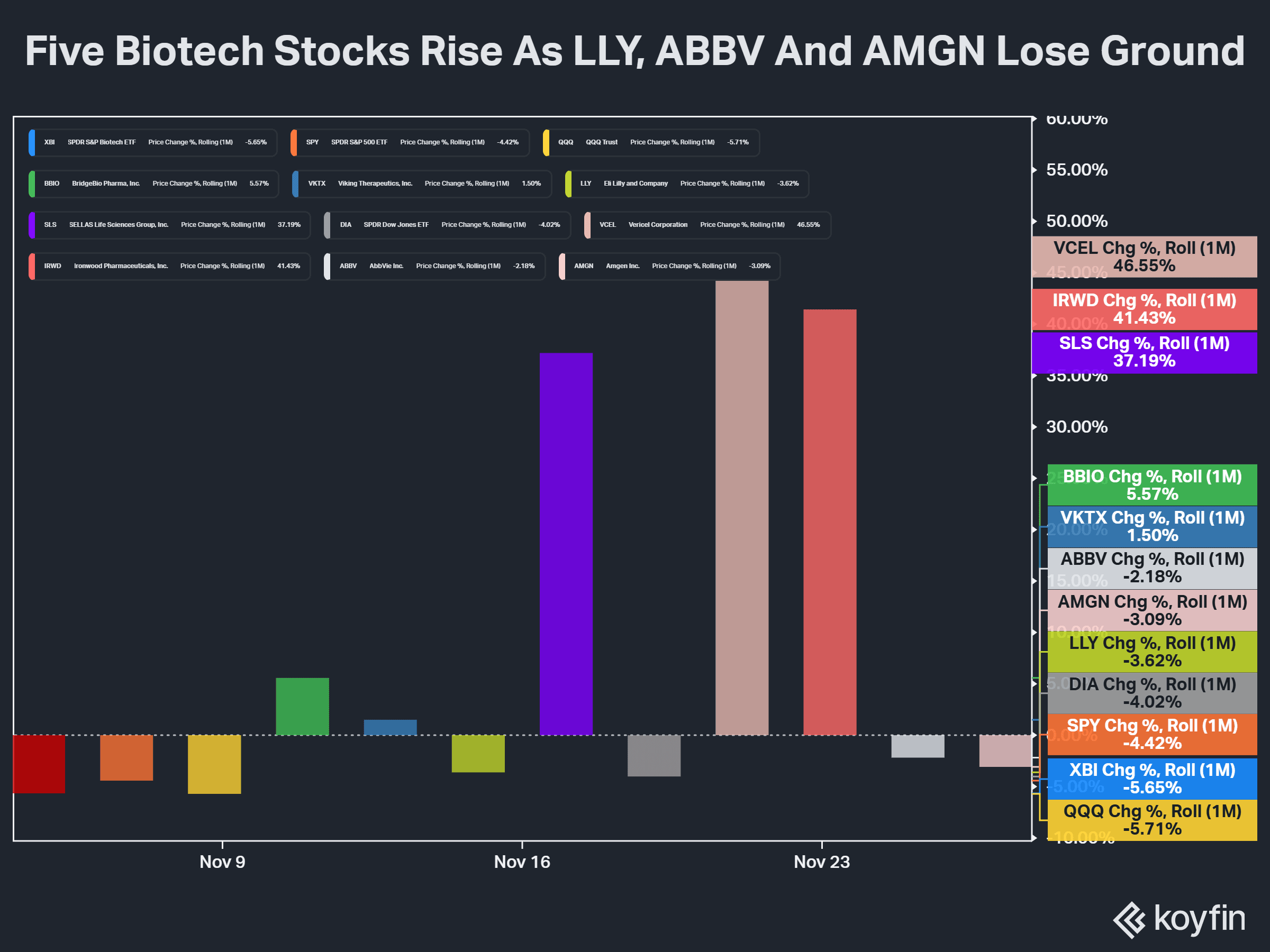
- VCEL led the five stocks with a 47% November gain after stronger knee implant and burn-care sales prompted it to raise its annual revenue forecast.
- IRWD climbed 41% as U.S. sales of Linzess, its drug with ABBV, surpassed the 2025 total in nine months.
- SLS jumped 156% in one session after its leukemia vaccine extended median survival from 14.7 to 24 months in a late-stage trial.
Advertisement|Remove ads.
Vericel and Ironwood Pharmaceuticals raised their sales forecasts on the same November morning and went on to gain more than 40% each, leading five biotech stocks that bucked a selloff that dragged down the sector and big pharma players Eli Lilly, AbbVie and Amgen.
Even a nearly 5% rebound on Monday left the SPDR S&P Biotech ETF (XBI) down 5.65% so far this month. Biotech fell more than the S&P 500 ETF (SPY) and the Dow ETF (DIA), down 4%, but fared slightly better than the Nasdaq-100 ETF (QQQ), which lost 5.71%. Big Pharma also slipped, with Eli Lilly (LLY) down 4%, Amgen (AMGN) off 3% and AbbVie (ABBV) down 2%.

Advertisement|Remove ads.
VCEL Leads November’s Gainers As Knee Implant Sales Climb
Vericel (VCEL) led the five with a 47% gain to $59 so far in November. Shares jumped nearly 14% on Nov.5 after the company raised its 2026 sales forecast. Its biggest seller, the MACI knee cartilage implant, brought in $67.4 million in the third quarter, up 21%. Burn-care sales rose 52% to $18 million, lifting total revenue 26% to $85.4 million. Net income nearly tripled to $14.2 million.
A sign of future demand came from the first step in the procedure. To make a MACI implant, Vericel grows cartilage from a small sample taken from the patient’s knee. More surgeons were collecting those samples, and surgeons already using MACI were taking more biopsies. “We achieved record third quarter MACI biopsies, implants, and biopsy and implanting surgeons,” CEO Nick Colangelo told analysts.
Vericel now expects $344 million to $346 million in 2026 revenue, up from $330 million to $340 million. Analysts raised their targets, too. Truist went from $52 to $65, and Stephens from $55 to $68. At an investor conference last week, the firm said it aims to launch MACI in the U.K. in the second half of 2027. Since it takes time to turn a biopsy into an implant, Vericel expects U.K. sales to contribute more in 2028.
Advertisement|Remove ads.
IRWD Raises Forecast As Linzess Prescriptions Climb
Ironwood Pharmaceuticals (IRWD) climbed 41% to $4.95 this month, even as AbbVie, its partner on the prescription constipation drug Linzess, lost ground. By the end of September, U.S. Linzess sales had reached $880 million, already topping the drug’s U.S. sales for all of 2025. Ironwood shares jumped 7% on Nov.5 when it raised its full-year forecast.
The two companies split U.S. profits from Linzess. In the third quarter, prescription demand rose 4.9%, and U.S. sales hit $325 million. Ironwood booked nearly $130 million from the partnership, accounting for almost all of its $133 million in quarterly revenue. It now expects full-year U.S. Linzess sales of $1.20 billion to $1.25 billion, up $50 million at both ends of the range. Ironwood also raised its own annual revenue forecast to $485 million to $510 million.
“We expect fourth quarter to be our strongest quarter of the year,” commercial chief and incoming CEO Tammi Gaskins told analysts. Cash from Linzess is helping Ironwood pay down debt and fund its next drug. The company repaid $60 million in the quarter, while expanding a confirmatory trial of Apraglutide for adults with short bowel syndrome who rely on intravenous nutrition or fluids.
Advertisement|Remove ads.
SLS Surges On Much-Awaited Leukemia Data
Sellas Life Sciences (SLS) jumped 156% on Nov. 17 after its experimental leukemia vaccine extended median survival by more than nine months in a late-stage trial. A discounted share offering followed, and the stock ended Monday at $13.28, still up 37% for November.
The Phase 3 Regal trial enrolled 126 patients with acute myeloid leukemia (AML) who were in their second or later remission. Patients who received the vaccine, Galinpepimut-S, lived a median of 24 months, compared with 14.7 months for those who received their doctors’ choice of treatment. The vaccine lowered the risk of death during the study by 41%. Sellas plans to meet with the FDA and aims to file for approval in the first half of 2027.
Sellas moved quickly to raise cash after the results. On Friday, it closed a $172.5 million offering at $13 per share, about 28% below its Nov. 18 closing price of $17.95.
Advertisement|Remove ads.
A second leukemia drug, Tambiciclib, could bring more news before year-end. Sellas previewed findings this month that it will present in December on patients whose leukemia had returned or resisted treatment. On Nov. 12, it said a separate trial testing Tambiciclib earlier in treatment had enrolled 40 of its planned 80 patients. Sellas expects preliminary results from that trial this quarter.
FDA Clears BBIO’s Muscular Dystrophy Drug 4 Days Early
BridgeBio Pharma (BBIO) gained 6% so far this month after the FDA approved Welgemda, the first U.S. treatment for any form of limb-girdle muscular dystrophy. The decision came four days ahead of the agency’s Nov. 27 deadline. Shares had already climbed about 4% to $79.13 that day when trading halted ahead of the news.
Welgemda is an oral drug for adults and children weighing at least 30 kilograms who have LGMD2I/R9, an inherited condition that gradually weakens the muscles. After a year in the pivotal trial, patients taking Welgemda walked faster on a timed 100-meter test than those taking a placebo. BridgeBio said it planned to launch the drug immediately through the U.S. network it built for its heart drug Attruby.
Advertisement|Remove ads.
“Our community has worked toward a moment like this, driven by the belief that a better future was possible,” said Sammy Brazzo, who lives with the disease and whose mother founded the CureLGMD2i Foundation.
Attruby, which brought in $253.2 million in third-quarter U.S. net sales, also had news in November. On Nov. 17, BridgeBio reported that a new analysis of its trial found patients taking Attruby had a 45% lower risk of a first heart-failure event over 30 months than those taking a placebo.
VKTX Erases Its November Loss In 1 Session
Viking Therapeutics (VKTX) turned a November loss into a gain in a single session. The obesity-drug developer closed Friday at $24.77, well below its October close of $27.28. On Monday, shares jumped 12%, leaving Viking up 1.5% for the month.
Advertisement|Remove ads.
Monday was the first trading day after a 60-day lock-up on share sales by Viking’s directors and executive officers expired on Nov.22. The agreement allowed sales under certain pre-existing trading plans.
Meanwhile, Viking’s latest drug data came on Nov.15 at ObesityWeek. An exploratory analysis of its Phase 2 trial found that 74% of patients who received weekly injections of VK2735 dropped at least one body mass index category in 13 weeks, compared with 15% of those on placebo. Viking is now testing the injection in 78-week Phase 3 trials and an oral version in its Sunrise program.
How Do Retail Traders Feel About Biotech Stocks And The Broader Market?
On Stocktwits, BBIO drew the strongest response of the five biotech gainers, with ‘extremely bullish’ sentiment and ‘extremely high’ message volume. Traders were also ‘bullish’ on SLS and VKTX, though message volume was ‘high’ for SLS and ‘normal’ for VKTX. The two biggest November gainers drew a cooler response: sentiment was ‘neutral’ on VCEL amid ‘normal’ volume and ‘bearish’ on IRWD amid ‘low’ volume.
Advertisement|Remove ads.
QQQ was the only ETF to match BBIO’s ‘extremely bullish’ sentiment. SPY and DIA were both ‘neutral’, even as all three ETFs saw ‘high’ message volume. Among the pharma giants, ABBV mirrored SLS with ‘bullish’ sentiment on ‘high’ volume, while LLY and AMGN both drew ‘bearish’ sentiment on ‘normal’ volume.
On Stocktwits, one user watching Vericel’s post-earnings run asked, “Can it push through $60?” Another user said Ironwood needed to clear $5 and hold it to keep climbing.
Advertisement|Remove ads.
A separate user said about Sellas: “cash handled changes the math on $SLS, a buyer is not rescuing them anymore, they are buying a Phase 3 survival hit with a filing path into first half of 2027. much cleaner pitch that way”
Another bullish user said on BridgeBio: “Attruby revenue is crushing and this approval opens another potential revenue stream.”
Advertisement|Remove ads.
So far this year, SLS led with a 252% gain, followed by VCEL at 64% and IRWD at 47%. All three outpaced AMGN, up 37%, LLY, up 27%, and ABBV, up 26%.
BBIO rose 3.5%, edging past DIA’s 3.2% gain but trailing SPY at 5.9% and QQQ at 6%. VKTX was the only November gainer among the five still down for the year, off 21%.
Advertisement|Remove ads.
For updates and corrections, email newsroom[at]stocktwits[dot]com.
Comments posted here will also appear on symbol pages.

Latest News

 Shivani Kumaresan·5m ago
 Yuvraj Malik·29m ago

 Anushka Basu·43m ago

 Deepti Sri·47m ago

 Aashika Suresh·1h ago
 Shivani Kumaresan·1h ago